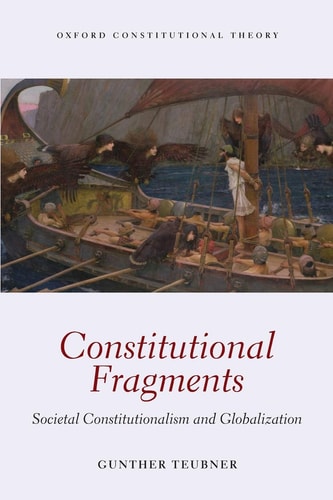
Constitutional Fragments: Societal Constitutionalism and Globalization
0
0
As an Amazon Associate and affiliate partner, Menrva Books earns from qualifying purchases. Learn more
Author Description
In recent years a series of scandals have challenged the traditional political reliance on public constitutional law and human rights as a safeguard of human well-being. Multinational corporations have violated human rights; private intermediaries in the internet have threatened freedom of opinion, and the global capital markets unleashed catastrophic risks. All of these phenomena call for a response from traditional constitutionalism. Yet it is outside the limits of the nation-state in transnational politics and outside institutionalized politics, in the 'private' sectors of global society that these constitutional problems arise.It is widely accepted that there is a crisis in traditional constitutionalism caused by transnationalization and privatization. How the crisis can be overcome is one of the major controversies of modern political and constitutional theory. This book sets out an answer to that problem. It argues that the obstinate state-and-politics-centricity of traditional constitutionalism needs to be counteracted by a sociological approach which, so far, has remained neglected in the constitutional debate. Constitutional sociology projects the questions of constitutionalism not only onto the relationship between public politics and law, but onto the whole society. It argues that constitutionalism has the potential to counteract the expansionist tendencies of social systems outside the state world, particularly of the globalized economy, science and technology, and the information media, when they endanger individual or institutional autonomy.The book identifies transnational regimes, particularly in the private area, as the new constitutional subjects in a global society, rivals to the order and power of nation states. It presents a model of transnational, societal constitutional fragments that could bring the values of constitutionalism to bear on these private networks, examining the potential horizontal application of human rights in the private sphe
Menrva's Summary
THE THESIS
This book investigates how the traditional state-centric model of constitutionalism can be adapted to address the challenges posed by transnationalization and the privatization of global social systems. Gunther Teubner, a prominent legal scholar, argues that constitutionalism must move beyond the nation-state to address the expansionist tendencies of globalized sectors like the economy, science, and technology. By applying a sociological lens, the author proposes a framework of societal constitutionalism to protect individual and institutional autonomy within private, transnational networks.
THE SCOPE MAP
What You Will Find
- Analysis of the crisis in traditional constitutional law caused by global capital markets and multinational corporations.
- A theoretical model for societal constitutionalism that extends beyond public politics.
- Examination of the horizontal application of human rights within private global spheres.
- Exploration of transnational regimes as new constitutional subjects that rival the power of the nation-state.
THE AUTHORITY PERSPECTIVE
Experts recognize this work as a foundational text in the field of global constitutional theory, particularly for its innovative application of systems theory to legal problems. Readers frequently note the academic density of the prose, which requires a strong background in legal and sociological theory to fully grasp the author's complex arguments.
Page Count:
232
Publication Date:
2014-04-01
Publisher:
Oxford University Press
ISBN-10:
0198713959
ISBN-13:
9780198713951
Constitutional Theory
Law
Professional Career & Trade
Globalization
Sociology
International business
Corporate governance
Community Tags
Other Editions(2)
Similar Books





Reader Comments
Share Your Thoughts
No comments yet. Be the first to share your thoughts!