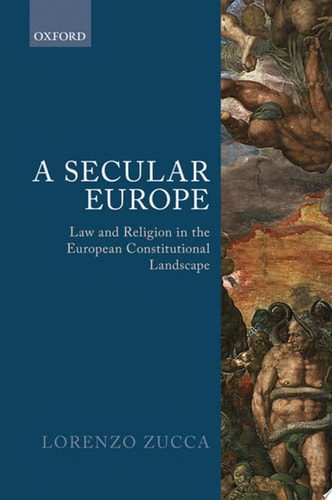
A Secular Europe: Law and Religion in the European Constitutional Landscape
0
0
As an Amazon Associate and affiliate partner, Menrva Books earns from qualifying purchases. Learn more
Author Description
How to accommodate diverse religious practices and laws within a secular framework is one of the most pressing and controversial problems facing contemporary European public order. In this provocative contribution to the subject, Lorenzo Zucca argues that traditional models of secularism, focusing on the relationship of state and church, are out-dated and that only by embracing a new picture of what secularism means can Europe move forward in the public reconciliation of its religious diversity.The book develops a new model of secularism suitable for Europe as a whole. The new model of secularism is concerned with the way in which modern secular states deal with the presence of diversity in the society. This new conception of secularism is more suited to the European Union whose overall aim is to promote a stable, peaceful and unified economic and political space starting from a wide range of different national experiences and perspectives. The new conception of secularism is also more suited for the Council of Europe at large, and in particular the European Court of Human Rights which faces growing demands for the recognition of freedom of religion in European states. The new model does not defend secularism as an ideological position, but aims to present secularism as our common constitutional tradition as well as the basis for our common constitutional future.
Menrva's Summary
THE THESIS
This book investigates how contemporary European states can reconcile diverse religious practices with a unified secular constitutional framework. Lorenzo Zucca, a scholar of legal philosophy, critiques traditional state-church separation models as insufficient for modern pluralistic societies. He proposes a revised model of secularism that functions as a common constitutional tradition rather than an ideological stance, aiming to provide a stable foundation for the European Union and the European Court of Human Rights.
THE SCOPE MAP
What You Will Find
- Analysis of the relationship between national legal traditions and European-wide constitutional standards.
- A proposed model of secularism focused on managing societal diversity rather than institutional separation.
- Examination of case law and jurisprudence from the European Court of Human Rights.
- Theoretical arguments regarding the role of secularism in fostering political and economic stability.
THE AUTHORITY PERSPECTIVE
Legal scholars and political scientists frequently cite this work for its nuanced approach to the intersection of human rights and religious freedom in Europe. Experts highlight the text as a significant contribution to constitutional theory, noting its utility for understanding the evolving role of secularism in supranational governance.
Page Count:
235
Publication Date:
2012-12-12
Publisher:
Oxford University Press
ISBN-10:
0199592780
ISBN-13:
9780199592784
Politics
Religion
Human rights
Law
Freedom of religion
Constitutional Law
Secularism
Professional Career & Trade
Community Tags
Similar Books