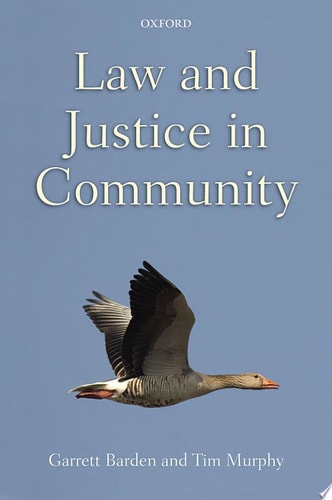
Law and Justice in Community
0
0
As an Amazon Associate and affiliate partner, Menrva Books earns from qualifying purchases. Learn more
Author Description
This book proposes a general theory of the nature of law based on the assertion that law exists in all human communities before it is ever posited or in any other sense formally expressed. According to the theory, the nature of law is not captured in what is variously called 'positive law', 'conventional law', 'state law' or 'human law'. The theory holds that a living law is an omnipresent feature of human community. By 'living law' is meant primarily those normative judgments and choices that are generally accepted and approved in a particular community.The book begins by exploring the origins of civil society and the function of law. The authors adopt the Roman law definition of justice as the willingness to give each what is due, and they examine the mutual rights or entitlements that must be for the most part honoured for any society to survive. In addition to distinguishing natural justice from conventional justice, and setting out in detail the distinction between distributive justice, rectificatory justice and reciprocal justice. The study proceeds to analyse justice and the trading order; the nature of adjudication and interpretation; the relationship between morality, law and legislation; natural law; rights; law and coercion; and the authority and legitimacy of law.While the authors invoke several classical and medieval sources, their account of law and justice in community is innovative and contemporary. It will be of interest to students of philosophy, social anthropology, political science, and those involved in the sociological study of law.
Menrva's Summary
THE THESIS
This book investigates the fundamental nature of law as an inherent, pre-formal feature of human community rather than a construct of state-imposed regulation. Authors Garrett Barden and Timothy Murphy argue that a 'living law' exists within the normative judgments and shared choices of any functioning society. By synthesizing classical and medieval philosophical traditions with contemporary social analysis, the authors provide a framework for understanding how justice and authority operate independently of formal legislation.
THE SCOPE MAP
What You Will Find
- A theoretical exploration of the origins of civil society and the functional necessity of law.
- Detailed distinctions between distributive, rectificatory, and reciprocal justice.
- Analysis of the intersection between morality, legislation, and the trading order.
- Examination of the legitimacy of law, rights, and the role of coercion in community maintenance.
THE AUTHORITY PERSPECTIVE
Experts identify this work as a significant contribution to legal philosophy that bridges the gap between classical jurisprudence and modern sociological study. Readers frequently note the academic density of the prose, which requires a foundational understanding of political theory and philosophical inquiry to fully grasp the authors' arguments.
Page Count:
330
Publication Date:
2010-10-17
Publisher:
Oxford University Press
ISBN-10:
0199592683
ISBN-13:
9780199592685
Philosophy
Law
Community Life
Law Philosophy
Social anthropology
Sociology
Community Tags
Similar Books