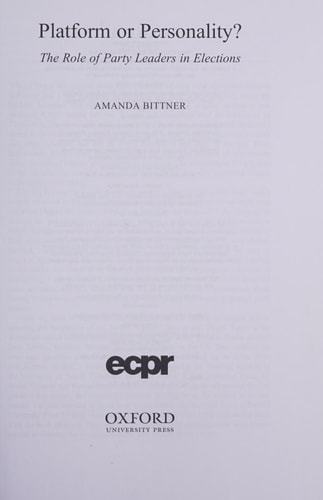
Platform or Personality?: The Role of Party Leaders in Elections
0
0
As an Amazon Associate and affiliate partner, Menrva Books earns from qualifying purchases. Learn more
Author Description
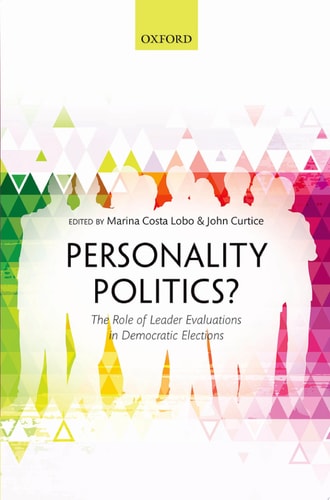
Campaign organizers and the media appear to agree that voters' perceptions of party leaders have an important impact in elections: considerable effort is made to ensure that leaders look good, speak well, and that they are up in the polls. In contrast, the academic literature is much more divided. Some suggest that leaders play an important role in the vote calculus, while others argue that in comparison to other factors, perceptions of leaders have only a minimal impact.Platform or Personality? incorporates data from thirty-five election studies across seven countries with varying institutional environments, and takes both a broad and in-depth look at the role of leaders. A few noteworthy conclusions emerge. First, voters evaluate leaders' traits in terms of two main dimensions, character and competence. Second, voters perceive leaders within the framework of a partisan stereotype in which the party label of the leader imbues meaning; more specifically, leaders of Conservative parties are seen to be more competent while Left leaders are seen to have more character. Third, and most importantly, leaders matter: they affect voters' decisions and have a discernible effect on the distribution of votes in an election. Fourth, there are consistent differences in the perception of party leaders according to voters' level of political sophistication. While all voters evaluate party leaders and consider leaders in their vote calculus, the more sophisticated do so the most. This book argues that personality plays an important role in elections, and that in a healthy democracy, so it should.Comparative Politics is a series for students, teachers, and researchers of political science that deals with contemporary government and politics. Global in scope, books in the series are characterized by a stress on comparative analysis and strong methodological rigour. The series is published in association with the European Consortium for Political Research.The Comparative Politics Series is edited by Professor David M. Farrell, School of Politics and International Relations, University College Dublin, Kenneth Carty, Professor of Political Science, University of British Columbia, and Professor Dirk Berg-Schlosser, Institute of Political Science, Philipps University, Marburg.
Menrva's Summary
THE THESIS
This book investigates the extent to which voter perceptions of party leaders influence electoral outcomes and the overall vote calculus. Amanda Bittner, a scholar in political science, utilizes a rigorous comparative framework to analyze how personality traits, party labels, and voter sophistication interact during election cycles. By synthesizing data from thirty-five election studies across seven countries, the author argues that party leaders exert a measurable and significant impact on the distribution of votes in modern democracies.
THE SCOPE MAP
What You Will Find
- Comparative analysis of thirty-five election studies across seven distinct national institutional environments.
- A dual-dimension framework for evaluating leader traits based on character and competence.
- Empirical evidence regarding the influence of partisan stereotypes on voter perception.
- Analysis of how political sophistication correlates with the weight voters assign to leader personality.
THE AUTHORITY PERSPECTIVE
Experts in the field of political science recognize this work as a rigorous contribution to the study of electoral behavior and leader effects. Scholars frequently cite the book for its methodological depth and its ability to bridge the gap between media-driven narratives and academic political theory.
Page Count:
272
Publication Date:
2011-07-02
Publisher:
Oxford University Press
ISBN-10:
0199595364
ISBN-13:
9780199595365
Comparative Politics
Political Behavior
Government
Political Leadership
Comparative Government
Elections
Community Tags
Similar Books









Reader Comments
Share Your Thoughts
No comments yet. Be the first to share your thoughts!