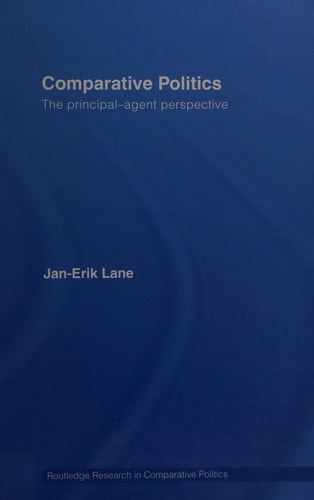
Comparative Politics: The Principal-Agent Perspective
0
0
As an Amazon Associate and affiliate partner, Menrva Books earns from qualifying purchases. Learn more
Author Description
Starting from the principal-agent perspective, this book offers a new analysis of government. It interprets political institutions as devices designed to solve the omnipresent principal-agent game in politics. In other words how to select, instruct, monitor and evaluate political agents or elites so that they deliver in accordance with the needs and preferences of their principal: the population. This book explores whether there are any evolutionary mechanisms in politics which guide mankind towards the rule of law regime, domestically and globally. It combines a cross-sectional approach with a longitudinal one. Comparing the extent of the rule of law among states, using a set of data from 150 countries concerning political and social variables, the author seeks to understand why there is such a marked difference among states. Taking a state-centred perspective and looking at countries with a population larger than one million people during the post Second World War period, the book examines: The stability and performance of states The conditions for the rule of law regime: economic, social, cultural and institutional ones The evolution of governments towards rule of law Comparative Politics - The Principle-Agent Perspective will be of interest to students and scholars of comparative politics, government, political theory and law.
Menrva's Summary
THE THESIS
This book investigates whether political institutions function as mechanisms designed to resolve the principal-agent game inherent in governance. Professor Jan-Erik Lane utilizes a principal-agent framework to analyze how populations select, monitor, and evaluate political elites to ensure accountability. By synthesizing cross-sectional and longitudinal data, the author examines the evolution of states toward the rule of law and the factors that contribute to institutional stability and performance.
THE SCOPE MAP
What You Will Find
- A comparative analysis of political and social variables across 150 countries.
- An examination of state performance and stability in the post-World War II era.
- A focus on nations with populations exceeding one million people.
- An assessment of the economic, social, cultural, and institutional conditions required for the rule of law.
THE AUTHORITY PERSPECTIVE
Scholars and students of political science frequently cite this work as a rigorous application of principal-agent theory to state-level governance. Experts highlight the text as a valuable resource for understanding the structural differences in institutional development across global political systems.
Page Count:
316
Publication Date:
2007-01-01
Publisher:
Routledge
ISBN-10:
0203935543
ISBN-13:
9780203935545
Law
Government
Comparative Government
Comparative Politics
State The
Rule Of Law
Political Theory
Community Tags
Similar Books