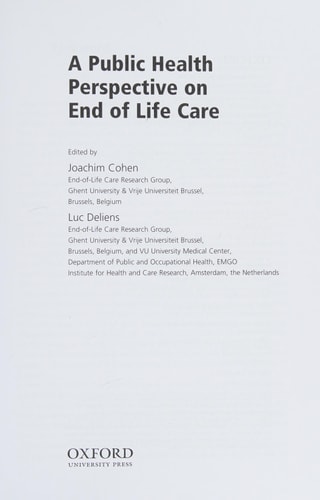
A Public Health Perspective on End of Life Care
0
0
As an Amazon Associate and affiliate partner, Menrva Books earns from qualifying purchases. Learn more
Author Description
Worldwide, more than 50 million people die each year and it is estimated on the basis of the conditions leading to death that up to 60% of them could benefit from some form of palliative care. It is a public health challenge to ensure that these people can access good palliative or end-of-life care. Pursuing good population health essentially also implies striving for a 'good enough death' and a good quality of care at the end of life. Safeguarding a good quality of the end of life for patient populations for whom it is appropriate requires a public health approach.In most developed countries ageing populations that increasingly die from chronic diseases after a prolonged -often degenerative- dying trajectory make up the public health challenges for palliative care. The very large baby boom generation will soon reach old age and can be expected to pose strong demands regarding the circumstances and care at their end of life. Only by applying a public health approach to palliative care (instead of individual patient perspectives), can societies successfully help to organize and plan end-of-life care in accordance with these aspirations.A Public Health Perspective on End of Life Care presents a synthesis and overview of relevant research and empirical data on the end of life that can bear a basis for a more systematic 'public health of the end of life'. The book focuses on population health, rather than clinical interventions or other aspects of individual health, and discusses studies using different methodologies (not only epidemiological research). The focus is on the quality of the end-of-life of populations, in particular from social sciences, environmental sciences, and humanities perspectives.
Menrva's Summary
THE THESIS
This book investigates how a population-level public health framework can address the global challenge of providing quality end-of-life care for aging societies. Joachim Cohen and Luc Deliens, both established experts in palliative care research, synthesize empirical data to argue that shifting focus from individual clinical interventions to systemic public health strategies is necessary to manage the increasing demand for end-of-life support. The text provides a comprehensive overview of how social, environmental, and humanities-based research can inform policy and organizational planning for dying trajectories in developed nations.
THE SCOPE MAP
What You Will Find
- Epidemiological data regarding global mortality and the demand for palliative care services.
- A framework for transitioning from individual-centered clinical care to population-based health strategies.
- Multidisciplinary research methodologies incorporating social sciences, environmental sciences, and humanities.
- Analysis of the impact of aging baby-boom populations on healthcare infrastructure and end-of-life planning.
THE AUTHORITY PERSPECTIVE
Experts recognize this work as a foundational text for integrating palliative care into broader public health policy. Readers frequently note the academic density of the prose, which serves as a rigorous resource for researchers and health policy professionals.
Page Count:
244
Publication Date:
2012-03-21
Publisher:
Oxford University Press
ISBN-10:
0199599408
ISBN-13:
9780199599400
Medicine
Sociology
Gerontology
Public Health
Community Tags
Similar Books