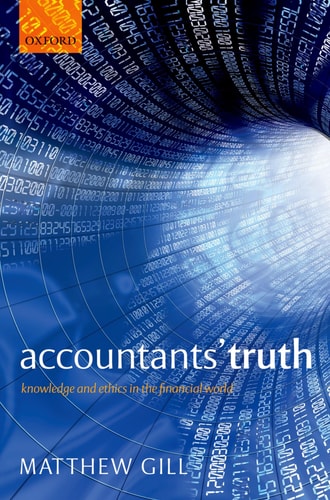
Accountants' Truth: Knowledge and Ethics in the Financial World
0
0
As an Amazon Associate and affiliate partner, Menrva Books earns from qualifying purchases. Learn more
Author Description
Accounting is the language of business, increasingly standardized across the world through powerful global corporations: a technical skill used to reach the correct, unquestionable answer. Yet, as recent corporate scandals have shown, a whole range of financial professionals (auditors, bankers, analysts, company directors) can collectively fail to question dubious actions. How can this be possible?To understand such failures, this book explores how accountants construct the technical knowledge they deem relevant to decision-making. In doing so, it not only offers a new way to understand deviance and scandals, but also suggests a reappraisal of accounting knowledge which has important implications for everyday commercial life.The book is based on interviews with chartered accountants working in the largest accountancy practices in London. The interviews reveal that although accounting decisions seem clear after they have been made, the process of making them is contested and opaque. Yet accountants nonetheless tend to describe their work as if it were straightforward and technical. Accountants' Truth digs beneath the surface to explore how accountants actually construct knowledge, and draws out the implications of that process with respect to issues such as professionalism, performance, transparency, and ethics.This important book concludes that accountants' technical discourse undermines their ethical reasoning by obscuring the ways in which accounting decisions must be thought through in practice. Accountants with particular ethical perspectives more readily understand and construct particular types of knowledge, so the two issues of knowledge and of ethics are inseparable. Increasingly technical accounting rules can therefore counterproductive. Instead, our best approach to avoiding future scandals is to redefine and reinvigorate professional ethics in the financial world.
Menrva's Summary
THE THESIS
This book investigates the fundamental tension between technical accounting rules and the ethical reasoning required to navigate complex financial decision-making. Matthew Gill, an expert in organizational sociology and accounting practices, utilizes qualitative research to challenge the perception of accounting as a purely objective, standardized process. By examining the gap between the technical discourse of professionals and the reality of their decision-making, the author argues that an over-reliance on rigid rules often obscures the ethical dimensions of commercial life.
THE SCOPE MAP
What You Will Find
- Qualitative data derived from in-depth interviews with chartered accountants in major London firms.
- An analysis of how technical knowledge is socially constructed within professional environments.
- A critical examination of the relationship between professional ethics and the application of accounting standards.
- A framework for understanding how corporate scandals emerge from the intersection of opaque decision-making and technical discourse.
THE AUTHORITY PERSPECTIVE
Experts recognize this work as a significant contribution to the sociology of finance, noting its ability to bridge the gap between abstract ethical theory and the daily realities of accounting practice. Readers frequently highlight the depth of the author's qualitative research, which provides a nuanced look at the professional culture within large-scale financial institutions.
Page Count:
208
Publication Date:
2011-05-19
Publisher:
Oxford University Press
ISBN-10:
0199603103
ISBN-13:
9780199603107
Corporate governance
Professionalism
Finance
Business Ethics
Accounting
Accountants
Community Tags
Other Editions(3)

Similar Books


Reader Comments
Share Your Thoughts
No comments yet. Be the first to share your thoughts!