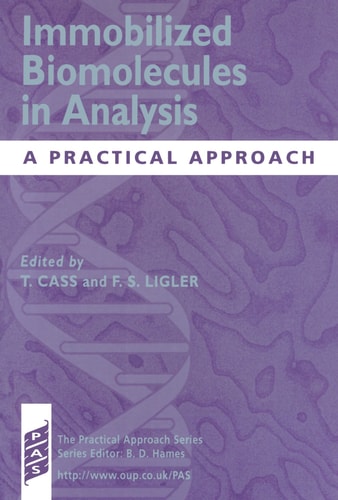
Immobilized Biomolecules in Analysis: A Practical Approach (Practical Approach Series, 198)
0
0
As an Amazon Associate and affiliate partner, Menrva Books earns from qualifying purchases. Learn more
Author Description
Biosensors are rising to the forefront of technology because they show that humans can harness the incredible functions of living molecules and cells and use them in valuable ways. Biomolecules and cells are critical components of biosensors. In order for these components to function in an artificial environment, they must be immobilized in a way that does not affect their interactions. This useful book provides a selection of the most current methods for immobilizing biomolecules and cells on a variety of surfaces so that they retain their functionality. The book also includes analytical techniques for measuring the functionality of immobilized biomolecules. All of the protocols have been tried and validated by the authors. The methods are easily repeatable, and the authors have carefully crafted the instructions so that they can be used without an extensive prior knowledge of biochemistry.Research in biosensors is carried out in a wide variety of fields including biochemistry, chemistry, engineering, laboratory medicine, environmental and defense research. This guide will be invaluable to researchers in all of these disciplines.
Menrva's Summary
THE THESIS
How can researchers effectively immobilize biomolecules and cells on artificial surfaces while preserving their biological functionality for use in biosensors? Authors Frances S. Ligler and Tony Cass provide a comprehensive technical framework for the stabilization of biological components in non-natural environments. By synthesizing validated laboratory protocols, the text addresses the critical challenge of maintaining molecular activity during the fabrication of analytical devices. The authors draw upon their extensive experience in biochemistry and engineering to offer a structured methodology suitable for both novice and expert practitioners.
THE SCOPE MAP
What You Will Find
- Detailed protocols for the immobilization of proteins, enzymes, and cells on diverse substrate materials.
- Analytical techniques for quantifying the functional retention of immobilized biological agents.
- Step-by-step instructions designed for repeatability across various laboratory settings.
- Cross-disciplinary applications spanning environmental monitoring, defense research, and clinical diagnostics.
THE AUTHORITY PERSPECTIVE
Experts recognize this volume as a foundational technical resource for those entering the field of biosensor development. Researchers frequently note the clarity of the instructions, which allow for successful implementation without requiring advanced prior knowledge of complex biochemical systems.
Page Count:
240
Publication Date:
1999-04-08
Publisher:
Oxford University Press
ISBN-10:
0199636362
ISBN-13:
9780199636365
Science
Biotechnology
Biosensors
Laboratory manuals
Biochemistry
Biomolecules
Community Tags
Similar Books