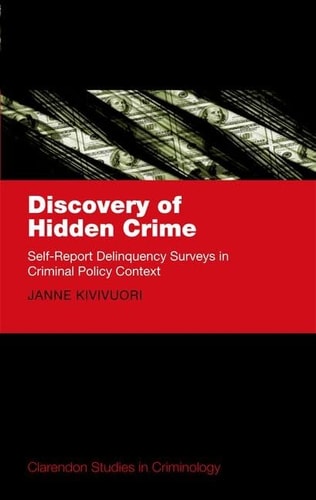
Discovery of Hidden Crime: Self-Report Delinquency Surveys in Criminal Policy Context
0
0
As an Amazon Associate and affiliate partner, Menrva Books earns from qualifying purchases. Learn more
Author Description
Discovery of Hidden Crime presents a history of the self-report crime survey as a method of criminological inquiry, describing how it was born within a distinct moral framework by pioneers out to show that crime was very prevalent and, therefore, normal.This books recounts how, during the 1930s and 1940s, a handful of US criminologists discovered the method of the self-report delinquency survey - a method used to ask people directly about their crimes. Previously, criminologists had to rely on official statistics produced by the police and other control authorities; their studies were therefore constrained by the 'official control barrier', which perpetuated the notion that crime was linked to the lowest social strata and/or to psychological abnormality. By confronting the domination of psychiatrists and psychologists in the study of crime, criminologists began to challenge the punitive attitudes of society; thus, exposing the so-called white collar offenders and alerting people to see crime as something that could also be found among the middle and upper classes.Expounding both the history of that discovery and its implications for criminological work, past and present, this book offers a fascinating perspective on how criminology has developed, and how it continues to advance amid the twin pressures of facts and policy goals.
Menrva's Summary
THE THESIS
This book investigates the historical evolution and methodological significance of self-report delinquency surveys as a tool for challenging traditional, state-sanctioned criminal statistics. Author Janne Kivivuori, a scholar in the field of criminology, examines the transition from reliance on official police data to the implementation of direct inquiry methods. By analyzing the work of mid-20th-century US criminologists, the text argues that these surveys were instrumental in shifting the perception of crime from a phenomenon exclusive to marginalized groups to a broader social reality encompassing all classes. The work provides a critical framework for understanding how research methodologies interact with prevailing policy goals and moral frameworks.
THE SCOPE MAP
What You Will Find
- Historical analysis of the emergence of self-report crime surveys during the 1930s and 1940s.
- Examination of the 'official control barrier' and its impact on early criminological data.
- Comparative study of sociological versus psychological approaches to understanding criminal behavior.
- Discussion on the influence of white-collar crime research on societal attitudes toward punishment.
THE AUTHORITY PERSPECTIVE
Experts recognize this work as a significant contribution to the history of criminological methodology and the sociology of deviance. Readers frequently note the academic density of the prose, which serves as a foundational text for students and researchers interested in the intersection of criminal policy and empirical research.
Page Count:
216
Publication Date:
2011-12-17
Publisher:
Oxford University Press
ISBN-10:
0199639191
ISBN-13:
9780199639199
History
Sociology
Criminology
Social Surveys
Research Methods
Crime Analysis
Criminals
Community Tags
Similar Books