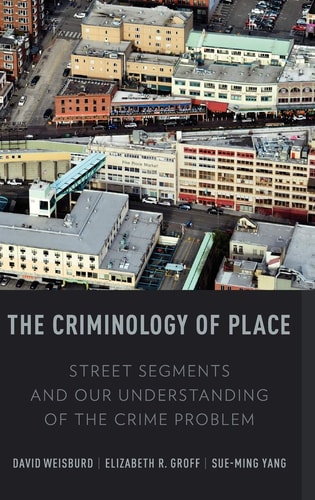
The Criminology of Place: Street Segments and Our Understanding of the Crime Problem
0
0
As an Amazon Associate and affiliate partner, Menrva Books earns from qualifying purchases. Learn more
Author Description
The study of crime has focused primarily on why particular people commit crime or why specific communities have higher crime levels than others. In The Criminology of Place, David Weisburd, Elizabeth Groff, and Sue-Ming Yang present a new and different way of looking at the crime problem by examining why specific streets in a city have specific crime trends over time. Based on a 16-year longitudinal study of crime in Seattle, Washington, the book focuses our attention on small units of geographic analysis-micro communities, defined as street segments. Half of all Seattle crime each year occurs on just 5-6 percent of the city's street segments, yet these crime hot spots are not concentrated in a single neighborhood and street by street variability is significant. Weisburd, Groff, and Yang set out to explain why.The Criminology of Place shows how much essential information about crime is inevitably lost when we focus on larger units like neighborhoods or communities. Reorienting the study of crime by focusing on small units of geography, the authors identify a large group of possible crime risk and protective factors for street segments and an array of interventions that could be implemented to address them. The Criminology of Place is a groundbreaking book that radically alters traditional thinking about the crime problem and what we should do about it.
Menrva's Summary
THE THESIS
This book investigates why specific street segments experience distinct crime trends over time, challenging traditional criminological focus on individuals or broad neighborhoods. The authors, David L. Weisburd, Elizabeth R. Groff, and Sue-Ming Yang, utilize a 16-year longitudinal dataset from Seattle, Washington, to argue that crime is highly concentrated at the micro-geographic level. By shifting the unit of analysis to street segments, they provide a framework for identifying specific risk and protective factors that remain invisible when crime is aggregated at the community or city level.
THE SCOPE MAP
What You Will Find
- A 16-year longitudinal analysis of crime patterns in Seattle, Washington.
- Micro-geographic methodology focusing on street segments rather than neighborhoods.
- Identification of specific risk and protective factors associated with localized crime hot spots.
- Proposed interventions tailored to address crime at the street-segment level.
THE AUTHORITY PERSPECTIVE
Experts in the field of criminology recognize this work as a significant shift in geographic analysis, often citing it for its rigorous longitudinal approach. Readers frequently note the academic density of the prose, which serves as a foundational text for those studying urban crime patterns and spatial analysis.
Page Count:
288
Publication Date:
2012-10-31
Publisher:
Oxford University Press
ISBN-10:
0195369084
ISBN-13:
9780195369083
Social Science
Sociology
Criminal Behavior Prediction Of
Public Policy
Urban Studies
Criminology
Crime Analysis
Community Tags
Similar Books