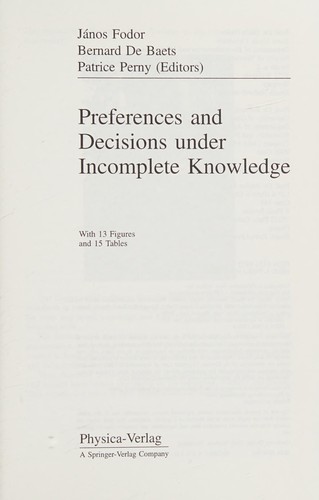
Preferences and Decisions Under Incomplete Knowledge
0
0
As an Amazon Associate and affiliate partner, Menrva Books earns from qualifying purchases. Learn more
Author Description
This book is a scholarly work that explores the intricate relationship between preferences, decisions, and the pervasive condition of incomplete knowledge. It presents a detailed analysis of theoretical models and empirical findings that illuminate how individuals and organizations navigate choices when faced with uncertainty and missing information. The content is drawn from a multidisciplinary perspective, integrating insights from economics, psychology, and game theory to provide a comprehensive understanding of decision-making processes. The book aims to offer a robust framework for analyzing and predicting behavior in situations where perfect information is unattainable.
Menrva's Summary
THE THESIS
This book investigates how individuals and groups make choices when faced with incomplete information. It delves into the theoretical frameworks and practical implications of decision-making under uncertainty, drawing on research from economics, psychology, and game theory. The author explores various models that attempt to capture the complexities of human behavior when not all relevant data is available, providing insights into how preferences are formed and decisions are ultimately reached.
THE SCOPE MAP
- Theoretical models of decision-making under uncertainty
- Analysis of how incomplete knowledge shapes preferences
- Applications of game theory to situations with limited information
- Exploration of behavioral economics principles in decision processes
- Case studies illustrating real-world applications of the theories
THE AUTHORITY PERSPECTIVE
The book is recognized as a significant contribution to the study of decision theory, particularly for its rigorous examination of incomplete knowledge. Experts in economics and game theory have noted its comprehensive approach to modeling complex choices. The work is considered a valuable resource for researchers and advanced students seeking to understand the nuances of decision-making in environments where information is scarce. Its theoretical depth and practical relevance make it a key text in the field.
Page Count:
224
Publication Date:
2000-01-01
ISBN-10:
3790813036
ISBN-13:
9783790813036
Economics
Science
Non-Fiction
Game theory
Decision Theory
Community Tags
Similar Books