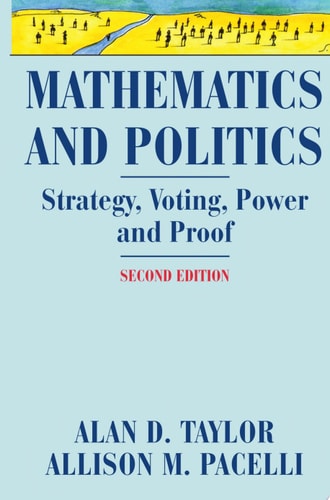
Mathematics and Politics
0
0
As an Amazon Associate and affiliate partner, Menrva Books earns from qualifying purchases. Learn more
Author Description
Why would anyone bid $3. 25 in an auction where the prize is a single dollar bill? Can one “game” explain the apparent irrationality behind both the arms race of the 1980s and the libretto of Puccini’s opera Tosca? How can one calculation suggest the president has 4 percent of the power in the United States federal system while another s- gests that he or she controls 77 percent? Is democracy (in the sense of re?ecting the will of the people) impossible? Questionslikethesequitesurprisinglyprovideaveryniceforumfor some fundamental mathematical activities: symbolic representation and manipulation, model–theoretic analysis, quantitative represen- tionandcalculation,anddeductionasembodiedinthepresentationof mathematical proof as convincing argument. We believe that an ex- sure to aspects of mathematics such as these should be an integral part of a liberal arts education. Our hope is that this book will serve as a text for freshman-sophomore level courses, aimed primarily at students in the humanities and social sciences, that will provide this sort of exposure. A number of colleges and universities already have interdisciplinary freshman seminars where this could take place. Most mathematics texts for nonscience majors try to show that mathematics can be applied to many different disciplines. A student’s viii PREFACE interest in a particular application, however, often depends on his or hergeneralinterestintheareainwhichtheapplicationistakingplace. Our experience at Union College and Williams College has been that there is a real advantage in having students enter the course knowing that virtually all the applications will focus on a single discipline—in this case, political science.
Menrva's Summary
THE THESIS
This book explores the surprising connections between mathematical concepts and political science, using mathematical tools to analyze political phenomena. The authors, Alan D. Taylor and Allison M. Pacelli, aim to provide students, particularly those in the humanities and social sciences, with an exposure to fundamental mathematical activities like symbolic representation, model-theoretic analysis, and quantitative calculation. They argue that understanding these mathematical aspects is crucial for a liberal arts education, and they focus their applications primarily on political science to maintain student interest. The book is intended as a text for freshman-sophomore level courses, potentially for interdisciplinary freshman seminars.
THE SCOPE MAP
- Analysis of auction theory, including why individuals might bid more than the prize value.
- Application of game theory to explain phenomena such as the arms race and historical events.
- Examination of power distribution within the U.S. federal system using mathematical calculations.
- Discussion on the inherent challenges to achieving democracy as a reflection of the people's will.
- Use of symbolic representation and manipulation to model political scenarios.
- Model-theoretic analysis to understand political structures and behaviors.
- Quantitative representation and calculation applied to political data.
- Presentation of mathematical proof as a form of convincing argument in political discourse.
THE AUTHORITY PERSPECTIVE
The book is designed as an accessible introduction to mathematical concepts for students in the humanities and social sciences, focusing on political science applications. Its approach suggests a text that bridges disciplines, aiming to demonstrate the utility of mathematics in understanding complex social and political issues. The premise of using mathematics to analyze topics ranging from auctions to presidential power indicates a curriculum that encourages analytical thinking and quantitative reasoning. The authors' stated goal is to integrate mathematical exposure into a liberal arts education, implying a pedagogical focus on clarity and relevance for a non-specialist audience.
Page Count:
364
Publication Date:
2008-09-16
Publisher:
Springer Nature
ISBN-10:
0387776451
ISBN-13:
9780387776453
Politics
Science
Non-Fiction
Logic
Mathematics
Decision Theory
Education
Game theory
Community Tags
Similar Books