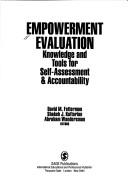
Empowerment Evaluation
0
0
As an Amazon Associate and affiliate partner, Menrva Books earns from qualifying purchases. Learn more
Author Description
This outstanding group of evaluators from academia, government, nonprofits, and foundations explores empowerment evaluation, a method for using evaluation concepts, techniques, and findings to foster improvement and self-determination. Empowerment Evaluation begins with an in-depth examination of this type of evaluation as it has been adopted in academic and foundation settings. The book then focuses on the various contexts in which empowerment evaluation is conducted, ranging from resistant environments (in which significant effort is required to move from passive-compliance orientations) to responsive environments (that already have a tradition of self-determination and community organizing). Interesting highlights concerning the role empowerment evaluation has played in the U.S. Department of Health and Human Services' substance abuse prevention programs are detailed throughout the book. The contributors also provide down-to-earth tools and technical assistance needed to conduct empowerment evaluation. This volume concludes with themes that emerge from the chapters and recommendations concerning next steps. This serves to strengthen the links between empowerment evaluation and community capacity building. This book provides evaluators and program participants with the tools to address the concerns of self-assessment and accountability through the use of empowerment evaluation.
Menrva's Summary
THE THESIS
This book explores empowerment evaluation, a methodology designed to foster improvement and self-determination through the application of evaluation principles. The work delves into the adoption of this approach in academic and foundation settings, examining its implementation across diverse environments, from those requiring significant effort to foster change to those already embracing self-determination. It highlights the role of empowerment evaluation in specific contexts, such as the U.S. Department of Health and Human Services' substance abuse prevention programs, and provides practical tools for evaluators and program participants. The volume concludes by synthesizing emergent themes and offering recommendations for future directions, ultimately strengthening the connection between empowerment evaluation and community capacity building.
THE SCOPE MAP
- Exploration of empowerment evaluation in academic and foundation settings.
- Analysis of empowerment evaluation in resistant and responsive environments.
- Case study detailing its application in U.S. Department of Health and Human Services' substance abuse prevention programs.
- Provision of practical tools and technical assistance for conducting empowerment evaluation.
- Discussion of themes emerging from various chapters.
- Recommendations for next steps in empowerment evaluation practice.
- Strengthening the links between empowerment evaluation and community capacity building.
THE AUTHORITY PERSPECTIVE
This volume is presented as a collection of insights from evaluators across various sectors, aiming to provide practical tools and a framework for empowerment evaluation. The text emphasizes the method's utility in fostering self-determination and improvement within programs. It highlights real-world applications and offers a synthesis of emergent themes and future directions, suggesting its value for both practitioners and those involved in community capacity building.
Page Count:
411
Publication Date:
1996-01-01
ISBN-10:
0761900241
Art
Non-Fiction
Health
Action
Self-help
Business
Community Development
Public Health
Community Tags
Similar Books