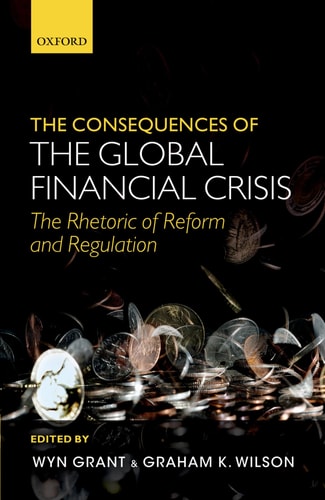
The Consequences of the Global Financial Crisis: The Rhetoric of Reform and Regulation
0
0
As an Amazon Associate and affiliate partner, Menrva Books earns from qualifying purchases. Learn more
Author Description
This is an open access title available under the terms of a CC BY-NC-ND 3.0 International licence. It is free to read at Oxford Scholarship Online and offered as a free PDF download from OUP and selected open access locations.The Global Financial Crisis is the most serious economic crisis since the Great Depression, and although many have explored its causes, relatively few have focused on its consequences. Unlike earlier crises, no new paradigm seems yet to have come forward to challenge existing ways of thinking and neo-liberalism has emerged relatively unscathed. This crisis, characterized by a remarkable policy stability, has lacked a coherent and innovative intellectual response.This book, however, systematically explores the consequences of the crisis, focusing primarily on its impact on policy and politics. It asks how governments responded to the challenges that the crisis has posed, and the policy and political impact of the combination of both the Global Financial Crisis itself and these responses.It brings together leading academics to consider the divergent ways in which particular countries have responded to the crisis, including the U.S., the UK, China, Europe, and Scandinavia. The book also assesses attempts to develop global economic governance and to reform financial regulation, and looks critically at the role of credit rating agencies.
Menrva's Summary
THE THESIS
This book investigates why the Global Financial Crisis failed to produce a significant shift in economic paradigms or a robust intellectual challenge to neo-liberalism. Authors Graham K. Wilson and Wyn Grant, alongside a cohort of academic contributors, analyze the political and policy responses of major global powers. They argue that despite the severity of the economic downturn, the period has been defined by remarkable policy stability rather than radical reform. The text examines the intersection of government intervention, regulatory attempts, and the persistent influence of existing financial structures.
THE SCOPE MAP
What You Will Find
- Comparative analysis of crisis responses in the U.S., UK, China, Europe, and Scandinavia.
- Critical evaluation of global economic governance frameworks and financial regulation reform.
- Examination of the institutional role and influence of credit rating agencies.
- Assessment of the political consequences resulting from government-led recovery efforts.
THE AUTHORITY PERSPECTIVE
Experts identify this work as a significant contribution to the study of post-crisis political economy. Readers frequently note the academic density of the prose, which provides a rigorous framework for understanding why policy inertia persisted following the 2008 financial collapse.
Page Count:
320
Publication Date:
2012-07-13
Publisher:
Oxford University Press
ISBN-10:
0199641986
ISBN-13:
9780199641987
Economics
Finance
Globalization
Public Policy
Community Tags
Similar Books