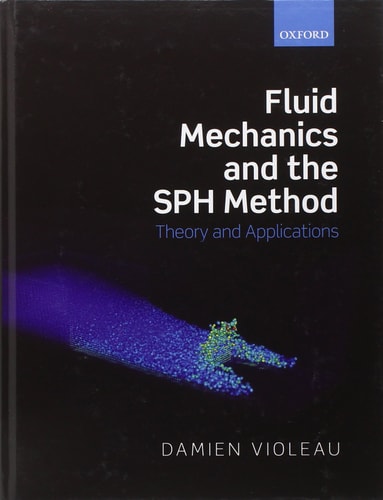
Fluid Mechanics and the SPH Method: Theory and Applications
0
0
As an Amazon Associate and affiliate partner, Menrva Books earns from qualifying purchases. Learn more
Author Description
This book presents the SPH method (Smoothed-Particle Hydrodynamics) for fluid modelling from a theoretical and applied viewpoint. It comprises two parts that refer to each other. The first one, dealing with the fundamentals of Hydraulics, is based on the elementary principles of Lagrangian and Hamiltonian Mechanics. The specific laws governing a system of macroscopic particles are built, before large systems involving dissipative processes are explained. The continua are discussed, and a fairly exhaustive account of turbulence is given. The second part discloses the bases of the SPH Lagrangian numerical method from the continuous equations, as well as from discrete variational principles, setting out the method's specific properties of conservativity and invariance. Various numerical schemes are compared, permanently referring to the physics as dealt with in the first part. Applications to schematic instances are discussed, and, ultimately, practical applications to the dimensioning of coastal and fluvial structures are considered.Despite the rapid growth in the SPH field, this book is the first to present the method in a comprehensive way for fluids. It should serve as a rigorous introduction to SPH and a reference for fundamental mathematical fluid dynamics. This book is intended for scientists, doctoral students, teachers, and engineers, who want to enjoy a rather unified approach to the theoretical bases of Hydraulics or who want to improve their skills using the SPH method. It will inspire the reader with a feeling of unity, answering many questions without any detrimental formalism.
Menrva's Summary
THE THESIS
This text investigates the theoretical foundations and practical implementation of the Smoothed-Particle Hydrodynamics (SPH) method for fluid modeling. Damien Violeau, an expert in the field, synthesizes principles from Lagrangian and Hamiltonian mechanics to provide a unified framework for understanding fluid behavior. The book bridges the gap between abstract mathematical fluid dynamics and the discrete numerical schemes required for engineering applications in coastal and fluvial environments.
THE SCOPE MAP
What You Will Find
- Fundamental principles of Lagrangian and Hamiltonian mechanics applied to macroscopic particles.
- Comprehensive analysis of turbulence and dissipative processes in fluid systems.
- Derivation of SPH numerical methods from continuous equations and discrete variational principles.
- Practical case studies regarding the dimensioning of coastal and fluvial structures.
THE AUTHORITY PERSPECTIVE
Experts identify this work as a foundational text that provides a rigorous, unified approach to SPH for both students and practicing engineers. Readers frequently note the high level of mathematical density, which serves as a comprehensive reference for those seeking to master the theoretical underpinnings of fluid simulation.
Page Count:
594
Publication Date:
2012-07-05
Publisher:
Oxford University Press
ISBN-10:
0199655529
ISBN-13:
9780199655526
Science
Mathematical Physics
Earth Sciences
Physics
Hydrodynamics
Engineering
Fluid dynamics
Mathematics
Hydraulics
Community Tags
Similar Books