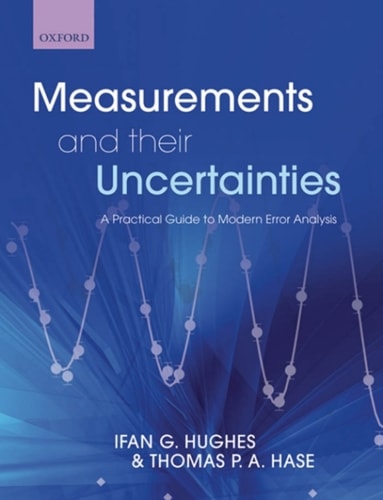
Measurements and Their Uncertainties: A Practical Guide to Modern Error Analysis
0
0
As an Amazon Associate and affiliate partner, Menrva Books earns from qualifying purchases. Learn more
Author Description
This hands-on guide is primarily intended to be used in undergraduate laboratories in the physical sciences and engineering. It assumes no prior knowledge of statistics. It introduces the necessary concepts where needed, with key points illustrated with worked examples and graphic illustrations. In contrast to traditional mathematical treatments it uses a combination of spreadsheet and calculus-based approaches, suitable as a quick and easy on-the-spot reference. The emphasis throughout is on practical strategies to be adopted in the laboratory. Error analysis is introduced at a level accessible to school leavers, and carried through to research level. Error calculation and propagation is presented though a series of rules-of-thumb, look-up tables and approaches amenable to computer analysis. The general approach uses the chi-square statistic extensively. Particular attention is given to hypothesis testing and extraction of parameters and their uncertainties by fitting mathematical models to experimental data. Routines implemented by most contemporary data analysis packages are analysed and explained. The book finishes with a discussion of advanced fitting strategies and an introduction to Bayesian analysis.
Menrva's Summary
THE THESIS
This text investigates the core problem of how to perform accurate error analysis and data interpretation within physical science and engineering laboratory environments. Authors Ifan G. Hughes and Thomas Hase provide a practical framework that bridges the gap between basic statistical concepts and advanced research-level data analysis. By utilizing a combination of spreadsheet-based methods and calculus, the authors establish a methodology that prioritizes immediate application over purely theoretical mathematical abstraction.
THE SCOPE MAP
What You Will Find
- Practical rules-of-thumb and look-up tables for error calculation and propagation
- Extensive application of the chi-square statistic for data fitting
- Methodologies for hypothesis testing and parameter extraction
- Introduction to Bayesian analysis and advanced fitting strategies
Scope Limits
- Does not provide a comprehensive theoretical derivation of all statistical proofs
- Focuses primarily on physical sciences and engineering rather than social science data sets
THE AUTHORITY PERSPECTIVE
Experts and educators frequently highlight this text as a highly accessible, foundational resource for undergraduate laboratory work. Readers often note that the balance between practical spreadsheet application and rigorous statistical theory makes it a useful reference for both students and researchers.
Page Count:
160
Publication Date:
2010-01-01
Publisher:
OUP Oxford
ISBN-10:
0191576565
ISBN-13:
9780191576560
Science
Statistics
Earth Sciences
Error analysis
Engineering
Mathematics
Physics
Education
Reference
Community Tags
Similar Books