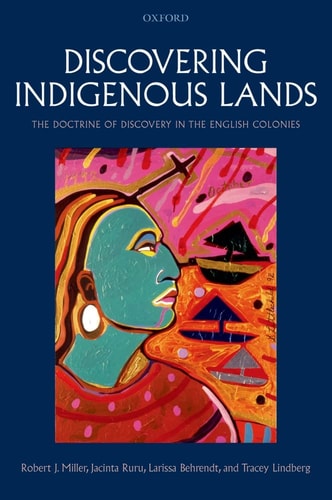
Discovering Indigenous Lands: The Doctrine of Discovery in the English Colonies
0
0
As an Amazon Associate and affiliate partner, Menrva Books earns from qualifying purchases. Learn more
Author Description
This book presents new material and shines fresh light on the under-explored historical and legal evidence about the use of the doctrine of discovery in Australia, Canada, New Zealand, and the United States.North America, New Zealand, and Australia were colonised by England under an international legal principle that is known today as the doctrine of discovery. When Europeans set out to explore and exploit new lands in the fifteenth through to the twentieth centuries, they justified their sovereign and property claims over these territories and the Indigenous peoples with the discovery doctrine. This legal principle was justified by religious and ethnocentric ideas of European and Christian superiority over the other cultures, religions, and races of the world. The doctrine provided that newly-arrived Europeans automatically acquired property rights in the lands of Indigenous peoples and gained political and commercial rights over the inhabitants. The English colonial governments and colonists in North America, New Zealand, and Australia all utilised this doctrine, and still use it today to assert legal rights to Indigenous lands and to assert control over Indigenous peoples.Written by Indigenous legal academics - an American Indian from the Eastern Shawnee Tribe, a New Zealand Maori (Ngati Rawkawa and Ngati Ranginui), an Aboriginal Australian (Eualayai/Gammilaroi), and a Cree (Neheyiwak) in the country now known as Canada - Discovering Indigenous Lands provides a unique insight into the insidious historical and contemporary application of the doctrine of discovery.
Menrva's Summary
THE THESIS
This work investigates how the doctrine of discovery functioned as a foundational legal instrument for European colonization and continues to influence contemporary land rights in settler-colonial states. The authors, a collective of Indigenous legal scholars from the United States, New Zealand, Australia, and Canada, synthesize historical evidence and legal precedents to demonstrate how religious and ethnocentric ideologies were codified into property and sovereign claims. By examining the application of this doctrine across four distinct nations, the text argues that the legal mechanisms of the past remain active in modern governance and land disputes.
THE SCOPE MAP
What You Will Find
- Comparative legal analysis of the doctrine of discovery in Australia, Canada, New Zealand, and the United States.
- Historical examination of fifteenth
- to twentieth-century international law and its application to Indigenous territories.
- Critical evaluation of how religious and ethnocentric justifications established property and political rights for European settlers.
- Analysis of the enduring impact of colonial legal frameworks on contemporary Indigenous land rights and sovereignty.
THE AUTHORITY PERSPECTIVE
Experts recognize this volume as a significant contribution to comparative legal history, particularly for its unique perspective provided by Indigenous scholars. Readers frequently note the academic rigor of the text and its utility in understanding the intersection of colonial law and modern Indigenous rights.
Page Count:
320
Publication Date:
2012-03-02
Publisher:
Oxford University Press
ISBN-10:
019965185X
ISBN-13:
9780199651856
History
Constitutional Law
Professional Career & Trade
Law
Colonialism
Civil Rights
Great Britain
Community Tags
Similar Books