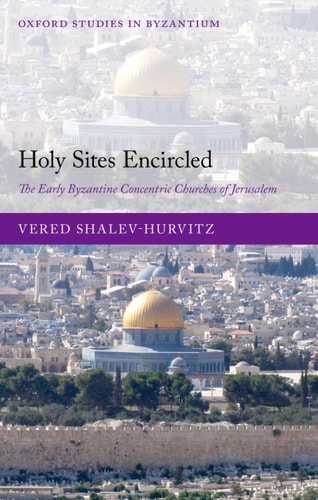
Holy Sites Encircled: The Early Byzantine Concentric Churches of Jerusalem
0
0
As an Amazon Associate and affiliate partner, Menrva Books earns from qualifying purchases. Learn more
Author Description
The round and octagonal churches of Jerusalem were the earliest of their kind. Powerful, monumental structures, recalling imperial mausolea and temples, they enshrined the holiest sites of Christianity. Constantine himself ordered the building of the first ones immediately after the council of Nicaea (325), his main objective being the authentication of Jesus's existence in Jerusalem in accordance with the council's resolutions, but the sites he chose in Palestine also obliterated reminiscences of Jewish or Pagan domination.Holy Sites Encircled demonstrates that all four concentric churches of Jerusalem encircled new holy sites exclusively relating to the corporeal existence of Jesus or Mary, and that they were self-contained, and apse-less because the liturgy, including the Mass, was performed from the venerated centre. Offering intimate concentric spaces, as well as perpetual processions around these sites, they promoted the development of new feasts, shaping the city's liturgy and that of the whole Christian world. They were found especially suitable to compete with former religious landmarks and therefore many of their descendants outside Jerusalem were cathedrals.This volume begins with the Church of the Holy Sepulchre, which replaced a pagan temple in Jerusalem city centre, and concludes with the Dome of the Rock, a unique Muslim structure, which was built by the Ummayads on the very site of the ruined Jewish Temple on Mount Moriah, using the concentric architecture of Jerusalem to establish their new authority. Illustrating how architectural form links together culture, politics, and society it explores the perceptions and architectural models that shaped these unusual churches and their impact, in both ideas and design, on future architecture.
Menrva's Summary
THE THESIS
This volume investigates the architectural and theological significance of early Byzantine concentric churches in Jerusalem, questioning how their unique circular and octagonal forms served to authenticate Christian holy sites and establish imperial authority. Vered Shalev-Hurvitz, a scholar specializing in Byzantine architecture and archaeology, utilizes a combination of historical records, site analysis, and architectural theory to argue that these structures were specifically designed to facilitate new liturgical practices centered on the physical presence of Jesus and Mary. By examining the transition from pagan and Jewish landmarks to Christian monuments, the author demonstrates how the built environment functioned as a tool for religious and political consolidation in the Holy Land.
THE SCOPE MAP
What You Will Find
- Analysis of the four primary concentric churches in Jerusalem, including the Church of the Holy Sepulchre.
- Examination of the architectural evolution from imperial mausolea and temples to Christian liturgical spaces.
- Comparative study of the Dome of the Rock as a successor to the concentric architectural tradition.
- Discussion on the intersection of urban planning, religious liturgy, and political legitimacy in the Byzantine period.
THE AUTHORITY PERSPECTIVE
Experts recognize this work as a significant contribution to the study of Byzantine architectural history and its role in shaping early Christian identity. Scholars frequently note the meticulous detail with which the author connects structural design to the broader socio-political context of the era.
Page Count:
520
Publication Date:
2015-05-26
Publisher:
Oxford University Press
ISBN-10:
0199653771
ISBN-13:
9780199653775
History
Architecture
Religion
Art History
Church Architecture
Archaeology
Byzantine History
Community Tags
Similar Books