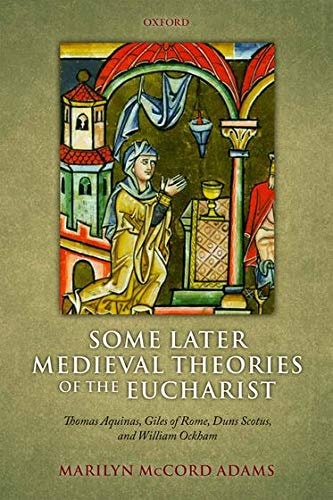
Some Later Medieval Theories of the Eucharist: Thomas Aquinas, Giles of Rome, Duns Scotus, and William Ockham
0
0
As an Amazon Associate and affiliate partner, Menrva Books earns from qualifying purchases. Learn more
Author Description
How can the Body and Blood of Christ, without ever leaving heaven, come to be really present on eucharistic altars where the bread and wine still seem to be? Thirteenth and fourteenth century Christian Aristotelians thought the answer had to be "transubstantiation."Acclaimed philosopher, Marilyn McCord Adams, investigates these later medieval theories of the Eucharist, concentrating on the writings of Thomas Aquinas, Giles of Rome, Duns Scotus, and William Ockham, with some reference to Peter Lombard, Hugh of St. Victor, and Bonaventure. She examines how their efforts to formulate and integrate this theological datum provoked them to make significant revisions in Aristotelian philosophical theories regarding the metaphysical structure and location of bodies, differences between substance and accidents, causality and causal powers, and fundamental types of change. Setting these developments in the theological context that gave rise to the question draws attention to their understandings of the sacraments and their purpose, as well as to their understandings of the nature and destiny of human beings.Adams concludes that their philosophical modifications were mostly not ad hoc, but systematic revisions that made room for transubstantiation while allowing Aristotle still to describe what normally and naturally happens. By contrast, their picture of the world as it will be (after the last judgment) seems less well integrated with their sacramental theology and their understandings of human nature.
Menrva's Summary
THE THESIS
This work investigates how medieval philosophers reconciled the theological doctrine of transubstantiation with the constraints of Aristotelian metaphysics. Marilyn McCord Adams, a distinguished philosopher, analyzes the intellectual labor of thinkers like Thomas Aquinas, Giles of Rome, Duns Scotus, and William Ockham. She argues that these theologians performed systematic revisions to Aristotelian categories—specifically regarding substance, accidents, and causality—to accommodate the Eucharist without abandoning the broader natural philosophy of the era.
THE SCOPE MAP
What You Will Find
- Comparative analysis of 13th and 14th-century scholastic theories on the Eucharist.
- Examination of metaphysical revisions concerning the location of bodies and the nature of accidents.
- Discussion of the integration between sacramental theology and human nature.
- Evaluation of the consistency between natural philosophy and eschatological frameworks.
THE AUTHORITY PERSPECTIVE
Scholars recognize this text as a rigorous examination of the intersection between medieval theology and Aristotelian logic. Readers frequently note the high level of technical density, making it a specialized resource for those already familiar with scholastic philosophy.
Page Count:
336
Publication Date:
2012-10-12
Publisher:
Oxford University Press
ISBN-10:
0199658161
ISBN-13:
9780199658169
Philosophy
Christianity
Metaphysics
Lords supper
Theology
Community Tags
Similar Books