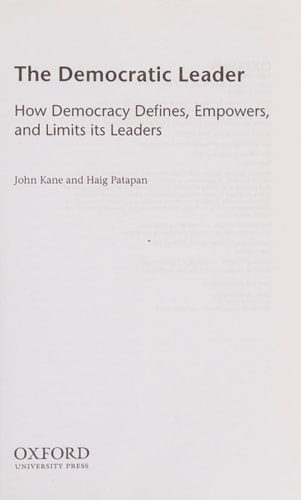
The Democratic Leader: How Democracy Defines, Empowers and Limits its Leaders
0
0
As an Amazon Associate and affiliate partner, Menrva Books earns from qualifying purchases. Learn more
Author Description
The Democratic Leader argues that leaders occupy a unique place in democracies. The foundational principle of democracy -- popular sovereignty -- implies that the people must rule. Yet the people can rule only by granting a trust of authority to individual leaders. This produces a tension that results in a unique type of leadership, specifically, democratic leadership. Democratic leaders, once they have the confidence and authority of the people, are very powerful because they rule through consent and not through fear. Yet in many respects they are the weakest of leaders, because democrats distrust leaders and impose on them a range of far-reaching constraints--legal, moral and political. The democratic leader must perpetually navigate the powerful and contending forces of public cynicism, founded in the suspicion that all leaders are self-interested power-seekers, and of public idealism, founded in a perennial hope that good leaders will act nobly by sacrificing themselves for the people. The Democratic Leader suggests that the inherent difficulty of this form of leadership cannot be resolved, and indeed is necessary for securing the strength and stability of democracy.
Menrva's Summary
THE THESIS
This book investigates the inherent paradox of leadership within democratic systems, where the necessity of authority conflicts with the foundational principle of popular sovereignty. Haig Patapan and John Kane, both established scholars in political theory, utilize a framework of political philosophy and historical analysis to examine how democratic leaders operate under the dual pressures of public cynicism and idealism. They argue that the tension between the power granted to leaders and the institutional constraints imposed upon them is not a flaw, but a vital component for maintaining democratic stability.
THE SCOPE MAP
What You Will Find
- Analysis of the tension between popular sovereignty and delegated authority
- Examination of the constraints placed on leaders, including legal, moral, and political frameworks
- Discussion of the psychological dynamics between public expectations and leader behavior
- Theoretical exploration of why democratic leadership remains perpetually unresolved
THE AUTHORITY PERSPECTIVE
Experts identify this work as a significant contribution to the study of political leadership and democratic theory. Readers frequently note the clarity of the authors' arguments regarding the structural limitations placed upon those who hold office in democratic states.
Page Count:
200
Publication Date:
2012-05-23
Publisher:
Oxford University Press
ISBN-10:
0199650470
ISBN-13:
9780199650477
Leadership
Political Leadership
Political Theory
Democracy
Government
Community Tags
Similar Books