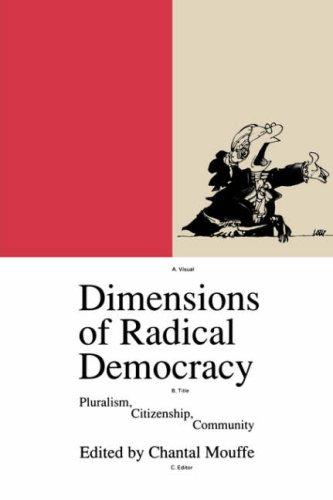
Dimensions of Radical Democracy
0
0
As an Amazon Associate and affiliate partner, Menrva Books earns from qualifying purchases. Learn more
Author Description
The themes of citizenship and community are today at the centre of a fierce debate as both Left and Right try to mobilize them for their cause. For the Left such notions are crucial in all the current attempts to redefine political struggle through extending and deepening democracy. But, argue the contributors to this volume, these concepts need to be made compatible with the pluralism that marks modern democracy. Rather than reject the liberal tradition, they argue, the aim should be to radicalize it. These essays set out to examine what types of 'citizen' and 'community' might be required by such a radical and plural democracy. From a range of disciplines and a fruitful diversity of theoretical perspectives, the contributors help us to address the following challenge: how to defend the greatest possible pluralism without destroying the very framework of the democratic political community. Despite their differences, a vision emerges from these essays which is sharply at odds both with the universalistic and rationalistic conception to be found in the work of Habermas, and with postmodern celebrations of absolute heterogeneity. For this book is an exploration of politics--of a politics where power, conflict and antagonism will always play a central role.--BOOK JACKET.
Menrva's Summary
THE THESIS
This volume investigates the tension between the need for a democratic political community and the imperative of radical pluralism. The book brings together contributors from various disciplines to explore what forms of citizenship and community are compatible with a deeply democratic society. It argues for a radicalization of the liberal tradition rather than its rejection, aiming to defend maximum pluralism without dismantling the democratic framework. The essays ultimately present a vision of politics where power, conflict, and antagonism are central, diverging from both Habermasian universalism and postmodern celebrations of absolute heterogeneity.
THE SCOPE MAP
- Exploration of citizenship and community in contemporary political debate.
- Analysis of how to reconcile pluralism with the framework of democratic political community.
- Examination of different theoretical perspectives on radical and plural democracy.
- Critique of Habermas's universalistic and rationalistic conception of democracy.
- Discussion of postmodern perspectives on heterogeneity in relation to democracy.
- Focus on the inherent role of power, conflict, and antagonism in politics.
- Contributions from a diversity of academic disciplines.
THE AUTHORITY PERSPECTIVE
The collection aims to redefine political struggle by extending and deepening democracy, arguing that concepts of citizenship and community must be made compatible with the pluralism inherent in modern democratic societies. The essays explore the types of citizen and community required for such a radical and plural democracy, seeking to defend the greatest possible pluralism without destroying the democratic political community itself. The contributors offer a vision of politics that acknowledges the central role of power, conflict, and antagonism, distinguishing their approach from both Habermasian universalism and postmodernist views.
Page Count:
254
Publication Date:
1992-01-01
ISBN-10:
0860913449
Philosophy
Science
Non-Fiction
Politics
Pluralism
Citizenship
Political Theory
Democracy
Community
Community Tags
Similar Books