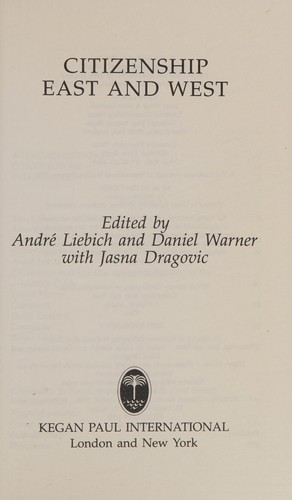
Citizenship, East and West
0
0
As an Amazon Associate and affiliate partner, Menrva Books earns from qualifying purchases. Learn more
Author Description
The outcome of the political transition in Eastern Europe depends not only on the politics pursued but on the understanding of politics in the countries involved. This volume examines a key aspect of this understanding, the notion of 'citizenship' as it is being defined in Eastern Europe today. Formally, 'citizenship' refers to the criteria of membership in a political community. More broadly, it raises key questions of identity, contract and culture, which bear upon the future of such issues as human rights, mobility and the relations between state and civil society in the post-communist world. This interdisciplinary collection brings together sociologists, jurists and political theorists from Poland, Hungary, Slovakia and the Czech Republic as well as from Switzerland, France, Great Britain and the United States. The volume seeks to articulate and compare the meanings and implications of 'citizenship' in terms of key issues and in several national contexts. Common to all contributions is the conviction that a comparison among different understandings of citizenship illuminates national specificities and brings into focus some of the constraints on the emergence of a democratic consensus shared by East and West.
Menrva's Summary
THE THESIS
This volume investigates the evolving concept of 'citizenship' in Eastern Europe following political transitions, examining its implications for identity, rights, and state-civil society relations. The book explores how the formal definition of membership in a political community is being redefined in post-communist nations, raising critical questions about human rights, mobility, and the broader cultural and contractual aspects of belonging. It brings together an interdisciplinary group of scholars from various Eastern and Western European countries, as well as the United States, to compare and articulate diverse understandings of citizenship. The central argument posits that comparing these varied interpretations illuminates national specificities and highlights the challenges in forging a shared democratic consensus between East and West.
THE SCOPE MAP
- Analysis of the concept of 'citizenship' in contemporary Eastern Europe.
- Exploration of 'citizenship' as a key aspect of political understanding during transition.
- Examination of formal criteria of membership in political communities.
- Discussion of broader questions concerning identity, contract, and culture related to citizenship.
- Focus on implications for human rights, mobility, and state-civil society relations in the post-communist world.
- Interdisciplinary contributions from sociology, law, and political theory.
- Comparative analysis of citizenship meanings across Poland, Hungary, Slovakia, the Czech Republic, Switzerland, France, Great Britain, and the United States.
- Illumination of national specificities and constraints on democratic consensus.
THE AUTHORITY PERSPECTIVE
This collection is presented as an interdisciplinary examination of citizenship in post-communist Eastern Europe, aiming to foster a comparative understanding across national contexts. The contributions are intended to highlight both specific national characteristics and the shared challenges in establishing democratic consensus between Eastern and Western Europe. The volume's structure suggests a scholarly approach, drawing on diverse academic fields to analyze a fundamental concept of political community. The overall goal is to articulate and compare the meanings and implications of citizenship in a period of significant political change.
Page Count:
223
Publication Date:
1995-01-01
ISBN-10:
0710304919
History
Non-Fiction
Politics
Citizenship
Sociology
Democracy
Community Tags
Similar Books