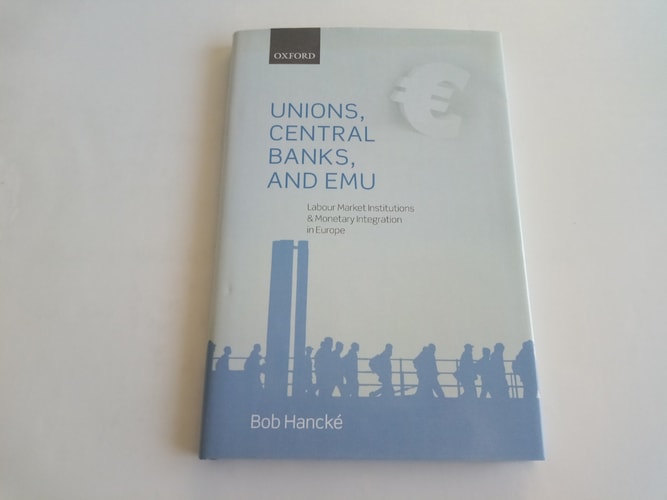
Unions, Central Banks, and EMU: Labour Market Institutions and Monetary Integration in Europe
0
0
As an Amazon Associate and affiliate partner, Menrva Books earns from qualifying purchases. Learn more
Author Description
This book examines the crisis of EMU through the lenses of comparative political economy. It retraces the development of wage-setting systems in the core and peripheral EMU member states, and how these contributed to the increasing divergence between creditor and debtor states in the late 2000s. Starting with the construction of the Deutschmark bloc, through the Maastricht process of the 1990s, and into the first decade of EMU, this book analyzes how labour unions and wage determination systems adjusted in response to monetary integration and, in turn, influenced the shape that monetary union would eventually take. Before the introduction of the Euro, labour unions were disciplined by central banks and governments, after social conflict in the north of the continent and with the use of social pacts in the others. Since controlling inflation had become the main goal of macro-economic policy, national central banks acted as a backstop to keep militant unions and profligate governments under control. Public sector wages thus were subordinated to manufacturing wages, a set-up policed by export sector unions, aided by the central bank. With the introduction of the single currency, the European Central Bank replaced the national central banks and, as a result, their capacity to control labour unions disappeared. The strong links between wages in the public sector unions and wages in the manufacturing export sector weakened dramatically in many countries, wage inflation re-emerged, and the stage was set for the current account divergences at the basis of the crisis of EMU.
Menrva's Summary
THE THESIS
This book investigates how the structural divergence of European labor market institutions contributed to the systemic crisis of the Economic and Monetary Union (EMU). Bob Hancké, a scholar of comparative political economy, utilizes historical data and institutional analysis to argue that the transition from national central bank oversight to the European Central Bank disrupted the wage-setting mechanisms that previously maintained economic stability. By examining the interplay between wage determination, manufacturing export sectors, and monetary policy, the author demonstrates how the loss of national control over inflation led to the current account imbalances observed in the late 2000s.
THE SCOPE MAP
What You Will Find
- Historical analysis of the Deutschmark bloc and the Maastricht process.
- Comparative study of wage-setting systems in core and peripheral EMU member states.
- Examination of the transition from national central bank discipline to the European Central Bank framework.
- Analysis of the relationship between public sector wages and manufacturing export sector competitiveness.
THE AUTHORITY PERSPECTIVE
Experts in political economy identify this work as a rigorous institutional analysis of the Eurozone crisis. Readers frequently note the academic density of the prose and the author's precise focus on the mechanics of labor market coordination.
Page Count:
168
Publication Date:
2013-06-10
Publisher:
Oxford University Press
ISBN-10:
0199662096
ISBN-13:
9780199662098
Economics
Europe
European Union
European History
Monetary unions
Labor Relations
Economic and Monetary Union
Community Tags
Similar Books