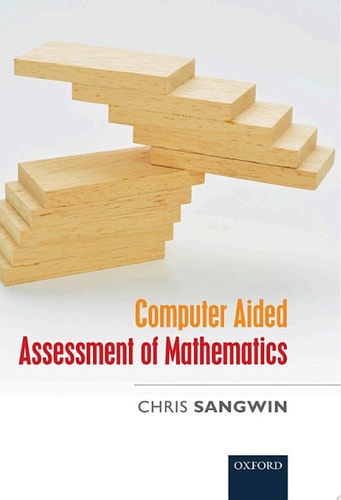
Computer Aided Assessment of Mathematics
0
0
As an Amazon Associate and affiliate partner, Menrva Books earns from qualifying purchases. Learn more
Author Description
Assessment is a key driver in mathematics education. This book examines computer aided assessment (CAA) of mathematics in which computer algebra systems (CAS) are used to establish the mathematical properties of expressions provided by students in response to questions. In order to automate such assessment, the relevant criteria must be encoded and, in articulating precisely the desired criteria, the teacher needs to think very carefully about the goals of the task. Hence CAA acts as a vehicle to examine assessment and mathematics education in detail and from a fresh perspective.One example is how it is natural for busy teachers to set only those questions that can be marked by hand in a straightforward way, even though the constraints of paper-based formats restrict what they do and why. There are other kinds of questions, such as those with non-unique correct answers, or where assessing the properties requires the marker themselves to undertake a significant computation. It is simply not sensible for a person to set these to large groups of students when marking by hand. However, such questions have their place and value in provoking thought and learning.This book, aimed at teachers in both schools and universities, explores how, in certain cases, different question types can be automatically assessed. Case studies of existing systems have been included to illustrate this in a concrete and practical way.
Menrva's Summary
THE THESIS
This book investigates the integration of computer algebra systems (CAS) into mathematics education to facilitate the automated assessment of student work. Chris Sangwin, an expert in mathematics education and assessment technology, argues that the process of encoding assessment criteria forces educators to refine their pedagogical goals. By moving beyond the limitations of manual, paper-based grading, the author provides a framework for utilizing technology to evaluate complex mathematical tasks that were previously impractical to assign to large cohorts.
THE SCOPE MAP
What You Will Find
- Methodologies for encoding mathematical properties into computer-based assessment systems.
- Analysis of question types that allow for non-unique or complex correct answers.
- Case studies demonstrating the practical implementation of existing computer-aided assessment systems.
- Strategies for transitioning from traditional manual grading to automated, property-based evaluation.
THE AUTHORITY PERSPECTIVE
Educators and researchers in the field of mathematics instruction view this work as a foundational text for understanding the intersection of software and pedagogy. Readers frequently note the technical clarity of the prose and its utility for teachers seeking to expand their assessment repertoire beyond simple multiple-choice formats.
Page Count:
192
Publication Date:
2013-06-14
Publisher:
Oxford University Press
ISBN-10:
0199660352
ISBN-13:
9780199660353
Mathematics
Pedagogy
Technology
Computer Science
Education