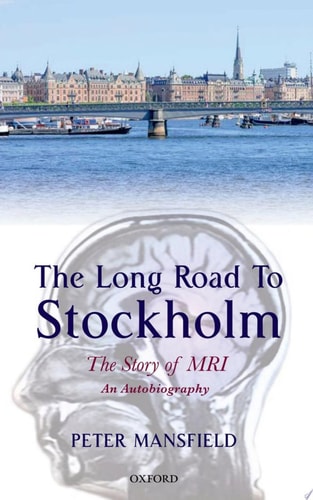
The Long Road to Stockholm: The Story of Magnetic Resonance Imaging
0
0
As an Amazon Associate and affiliate partner, Menrva Books earns from qualifying purchases. Learn more
Author Description
In this autobiography, Sir Peter Mansfield describes his life from war time childhood that initially sparked his interest in physics to his work in magnetic resonance imaging (MRI) that eventually led to the award of the Nobel Prize in 2003.Peter Mansfield grew up in London, but was evacuated to Devon during the blitz and following the V1 and V2 attacks on London. At the end of hostilities, he worked briefly in the printing industry before deciding to pursue his real interests in science by joining the Rocket Propulsion Department at Westcott near Aylesbury. Following a period of National Service and his studies at Queen Mary College, University of London, he married and moved to the USA for two years, returning in 1964 as a Lecturer in Physics at the University of Nottingham.In 1972 he spent a sabbatical period in Heidelberg, and during this period corresponded with his student, Peter Grannell, in Nottingham on the novel idea of magnetic resonance imaging. This led to his first paper on MRI which was presented at the first Specialised Colloque Ampere in 1973. During this period, he demonstrated how the MRI radio signals can be analysed and turned into images of the body. In 2003 the Nobel Prize in Physiology or Medicine was awarded jointly to Sir Peter and Paul Lauterbur for their crucial achievements in the development of MRI.
Menrva's Summary
THE THESIS
This autobiography explores the personal and professional trajectory of Sir Peter Mansfield, focusing on the scientific inquiries that culminated in the development of magnetic resonance imaging (MRI). The author details his transition from a wartime childhood in London to his academic career in physics, documenting the specific experimental challenges he faced at the University of Nottingham. By chronicling his early interest in rocket propulsion and his subsequent academic research, Mansfield provides a firsthand account of the technical hurdles and collaborative efforts required to transform radio signals into diagnostic medical imagery.
THE SCOPE MAP
What You Will Find
- A chronological account of the author's life from childhood in London to his Nobel Prize recognition.
- Technical insights into the early development of MRI radio signal analysis.
- Primary source reflections on the academic environment at the University of Nottingham and his sabbatical in Heidelberg.
- Contextual history regarding the 2003 Nobel Prize in Physiology or Medicine.
THE AUTHORITY PERSPECTIVE
Experts and historians of science view this text as a primary source for understanding the origins of modern medical imaging technology. Readers frequently note the accessible nature of the prose, which balances technical scientific detail with personal narrative reflection.
Page Count:
232
Publication Date:
2013-03-01
Publisher:
Oxford University Press
ISBN-10:
0199664544
ISBN-13:
9780199664542
Biography
Science
Autobiography
Physics
MEDICAL History
Medical instruments and apparatus
Technology
Great Britain
Scientists
Physicists biography
Community Tags
Similar Books