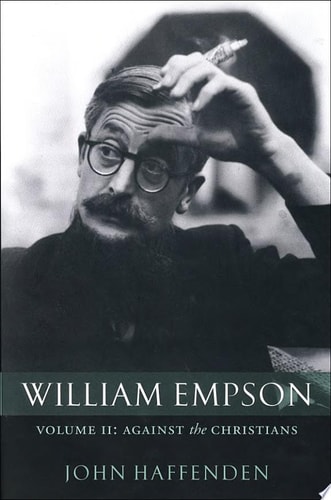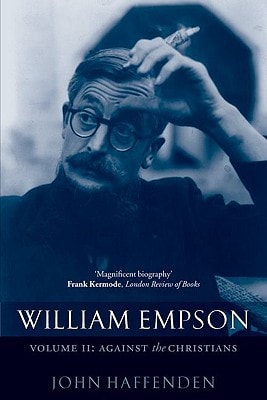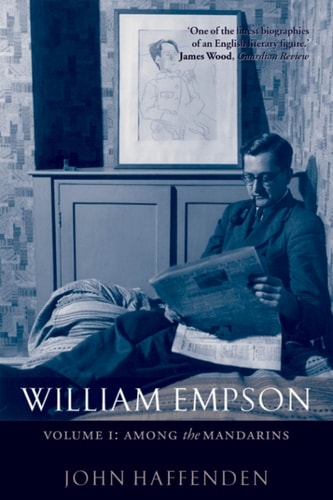
William Empson, Volume I: Among the Mandarins
0
0
As an Amazon Associate and affiliate partner, Menrva Books earns from qualifying purchases. Learn more
Author Description
William Empson was the foremost English literary critic of the twentieth century. He was a man of huge energy and curiosity, and a genuine eccentric who remained imperturbable in the face of all the extraordinary circumstances in which he found himself. The discovery of contraceptives in his possession by a bedmaker at Cambridge University led to his being robbed of a promised Fellowship. Yet Seven Types of Ambiguity, drafted while he was still an undergraduate, promptly brought him world-wide fame. Empson invented modern literary criticism in English. He acted too as a cultural fifth-columnist, challenging received doctrine in life and literature. 'It is a very good thing for a poet... to be saying something which is considered very shocking at the time,' he maintained. 'To become morally independent of one's formative society... is the grandest theme of all literature, because it is the only means of moral progress.' His public life took him through many of the major political events of the modern world -- the rise of imperialism in Japan, the Sino-Japanese war in China, wartime propaganda for the BBC, and the Chinese civil war and Communist takeover of Peking in 1949. His friends and critical sparring partners included I. A. Richards, Kathleen Raine, J. B. S. Haldane, Humphrey Jennings, George Orwell, Robert Lowell, Dylan Thomas, Stephen Spender, Helen Gardner, and T. S. Eliot. 'It is of great importance now that writers should try to keep a certain world-mindedness,' he insisted. 'Without the literatures you cannot have a sense of history, and history is like the balancing-pole of the tightrope-walker...; and nowadays we very much need the longer balancing-pole of not national but world history.' His passionate world-mindedness, and his humanism, combativeness, and wit, are fully in evidence in this, the first of two volumes exploring his remarkable life and work.
Menrva's Summary
THE THESIS
This volume investigates the formative years and intellectual development of William Empson, questioning how his eccentric personality and radical critical theories shaped the landscape of twentieth-century English literature. John Haffenden, a meticulous biographer, utilizes extensive archival research and personal correspondence to document Empson's trajectory from his early academic life at Cambridge to his global experiences in Japan and China. The narrative argues that Empson's work functioned as a form of cultural subversion, positioning him as a central figure in the evolution of modern critical thought.
THE SCOPE MAP
What You Will Find
- Detailed account of Empson's academic career and his early publication of Seven Types of Ambiguity.
- Historical context regarding the Sino-Japanese war and the Chinese Communist takeover of 1949.
- Documentation of Empson's professional relationships with figures such as T. S. Eliot, George Orwell, and I. A. Richards.
Scope Limits
- This volume concludes before the end of Empson's life, as it is the first of a two-part biographical project.
- The text focuses primarily on his public and intellectual life rather than an exhaustive analysis of his private domestic affairs.
THE AUTHORITY PERSPECTIVE
Scholars and critics recognize this work as the definitive biographical account of Empson's complex life and career. Readers frequently note the academic density of the prose, which provides a comprehensive look at the historical and literary currents of the era.
Page Count:
720
Publication Date:
2009-01-01
Publisher:
Oxford University Press
ISBN-10:
0191570516
ISBN-13:
9780191570513
History
Biography
Non-Fiction
20th Century
Literary Criticism
Great Britain
English & College Success
English
Critics
Community Tags
Similar Books