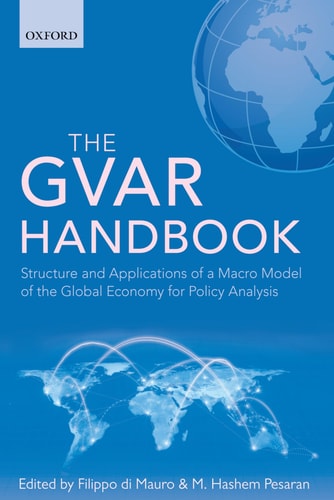
The GVAR Handbook: Structure and Applications of a Macro Model of the Global Economy for Policy Analysis
0
0
As an Amazon Associate and affiliate partner, Menrva Books earns from qualifying purchases. Learn more
Author Description
The GVAR is a global Vector autoregression model of the global economy. The model was initially developed in the early 2000 by Professor Pesaran and co-authors, for the main purpose of analysing credit risk in a globalised economy. Starting from mid-2000 the model was substantially enlarged in the context of a project financed by the ECB, to comprise all major economies and the Euro area as a whole. The purpose of this version was to exploit the rich modelisation of international linkages in order to simulate and analyse global macro scenarios of high policy interest.The rich, yet manageable, specification of international linkages has stimulated a vast literature on the GVAR. Since early 2011, the basic model - and its data base - has also available on a dedicated GVAR-Toolbox website with an easy-to-use interface allowing practical applications by an extended audience, as well as more complex analysis by the expert public.The book provides an overview of the extensions and applications of the GVAR which have been developed in recent years. Such applications are grouped in three main categories: 1) International transmission and forecasting; 2) Finance applications; and 3) Regional applications. By using a language which is accessible to not econometricians, the book reaches out to the extended audience of practitioners and policy makers interested in understanding channels and impacts of international linkages.
Menrva's Summary
THE THESIS
This handbook investigates the structural framework and practical applications of the Global Vector Autoregression (GVAR) model for analyzing complex international economic linkages. Authors Filippo di Mauro and M. Hashem Pesaran, both distinguished experts in econometrics, synthesize the evolution of the GVAR model from its origins in credit risk analysis to its current status as a comprehensive tool for global macroeconomic policy simulation. The text provides a structured overview of how the model captures interdependencies between major economies and the Euro area, offering a methodology for both academic research and practical policy decision-making.
THE SCOPE MAP
What You Will Find
- A comprehensive overview of the GVAR model architecture and its historical development.
- Methodological guidance on simulating global macro scenarios and international transmission channels.
- Categorized applications covering international forecasting, financial market analysis, and regional economic studies.
- Practical insights into using the GVAR-Toolbox for both standard and complex econometric modeling.
THE AUTHORITY PERSPECTIVE
Experts recognize this volume as a primary reference for understanding the mechanics of global economic modeling and its utility in policy environments. Readers frequently note the balance between technical rigor and accessible prose, making it a valuable resource for both professional economists and policy practitioners.
Page Count:
304
Publication Date:
2013-05-05
Publisher:
Oxford University Press
ISBN-10:
0199670080
ISBN-13:
9780199670086
Economics
Regression analysis
Macroeconomics
Global Economy
Finance
Econometrics
Community Tags
Similar Books