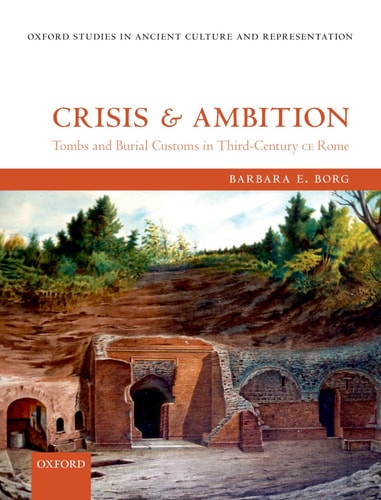
Crisis and Ambition: Tombs and Burial Customs in Third-Century AD Rome
0
0
As an Amazon Associate and affiliate partner, Menrva Books earns from qualifying purchases. Learn more
Author Description
Tombs and burial customs are an exquisite source for social history, as their commemorative character inevitably expresses much of the contemporaneous ideology of a society. This book presents, for the first time, a holistic view of the funerary culture of Rome and its surroundings during the third century AD. While the third century is often largely ignored in social history, it was a transitional period, an era of major challenges -- political, economic, and social -- which inspired creativity and innovation, and paved the way for the new system of late antiquity.Barbara Borg argues that during this time there was, in many ways, a return to practices known from the Late Republic and early imperial period, with spectacular monuments for the rich, and a large-scale reappearance of collective burial spaces. Through a study of terraced tombs, elite monuments, the catacomb nuclei, sarcophagi, and painted image decoration, this volume explores how the third century was an exciting period of experimentation and creativity, a time when non-Christians and Christians shared fundamental ideas, needs, and desires as well as cemeteries, tombs, and hypogea. Ambition continued to be a driving force and a determining factor in all social classes, who found innovative solutions to the challenges they encountered.
Menrva's Summary
THE THESIS
This book investigates how funerary practices and tomb architecture in third-century Rome reflect the social, political, and economic shifts of a transitional era. Barbara E. Borg, a scholar of Roman archaeology and culture, utilizes a comprehensive analysis of material evidence to challenge the perception of the third century as a period of decline. She argues that the era was marked by significant innovation and a strategic return to earlier cultural practices, demonstrating how diverse social classes navigated instability through creative commemorative expression.
THE SCOPE MAP
What You Will Find
- Analysis of third-century funerary architecture including terraced tombs and elite monuments.
- Examination of sarcophagi and painted image decoration as primary historical evidence.
- Comparative study of Christian and non-Christian burial spaces and shared cultural values.
- Investigation into the role of social ambition and economic adaptation during the transition to late antiquity.
THE AUTHORITY PERSPECTIVE
Scholars recognize this work as a foundational text for understanding the material culture of the Roman third century. Readers frequently note the academic density of the prose and the meticulous detail provided in the analysis of archaeological sites.
Page Count:
336
Publication Date:
2013-11-15
Publisher:
Oxford University Press
ISBN-10:
0199672733
ISBN-13:
9780199672738
History
Archaeology
Rome
Funeral Rites
Social History
Burial
Community Tags
Similar Books