The Rhetoric of Identity in Isocrates
0
0
As an Amazon Associate and affiliate partner, Menrva Books earns from qualifying purchases. Learn more
Author Description
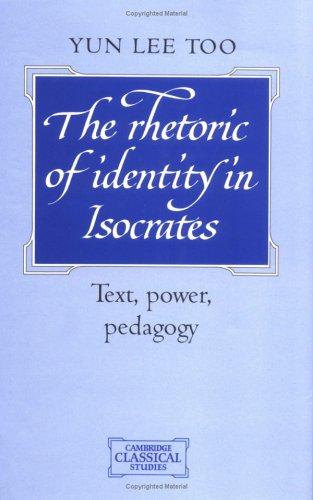
The rhetoric of identity in Isocrates offers a sustained interpretation of the Isocratean corpus, showing that rhetoric is a language which the author uses to create a political identity for himself in fourth-century Athens. Dr Too examines how Isocrates' discourse addresses anxieties surrounding the written word in a democratic culture which values the spoken word as the privileged means of political expression. Isocrates makes written culture the basis for a revisionary Athenian politics and of a rhetoric of Athenian hegemony. In addition, Isocrates takes issue with the popular image of the professional teacher in the age of the sophist, combating the negative stereotype of the greedy sophist who corrupts the city's youth in his portrait of himself as a teacher of rhetoric. He daringly reinterprets the pedagogue as a figure who produces a discourse which articulates political authority.. This book offers an interdisciplinary approach to ancient rhetoric and should appeal to people with interests in the fields of classics, history, the history of political thought, literature, literary theory, philosophy and education. All passages in Greek and Latin have been translated to ensure accessibility to non-classicists.
Menrva's Summary
THE THESIS
The book investigates how the ancient Greek orator and rhetorician Isocrates utilized rhetoric to construct his political identity and advocate for Athenian hegemony in fourth-century Athens. Yun Lee Too examines Isocrates' discourse in the context of Athenian democratic culture, which privileged spoken word over written word, and explores the anxieties surrounding written texts. The author demonstrates how Isocrates leveraged written culture to propose a revised Athenian politics and a rhetoric of dominance, while also reframing the public perception of himself as a teacher of rhetoric, countering the negative stereotype of the sophist.
THE SCOPE MAP
- Analysis of Isocrates' corpus to understand his construction of political identity.
- Examination of the tension between written and spoken word in Athenian democracy.
- Exploration of Isocrates' use of rhetoric to promote Athenian hegemony.
- Reinterpretation of the pedagogue figure as a producer of political authority.
- Discussion of the negative stereotype of the sophist and Isocrates' self-portrayal.
- Interdisciplinary approach appealing to classics, history, political thought, literature, literary theory, philosophy, and education.
- Inclusion of translated Greek and Latin passages for accessibility.
THE AUTHORITY PERSPECTIVE
This book offers a sustained interpretation of Isocrates' rhetorical works, focusing on his construction of political identity and Athenian hegemony. It is noted for its interdisciplinary approach, making it accessible to scholars and students across classics, history, political thought, literature, philosophy, and education. The inclusion of translated passages enhances its utility for a broader audience. The work engages with the cultural anxieties of fourth-century Athens regarding the written word in a democratic society.
Page Count:
274
Publication Date:
1995-01-01
ISBN-10:
052147406X
Politics
History
Non-Fiction
Classics
Political Thought
Ancient History
Literary theory
Rhetoric
Community Tags
Similar Books