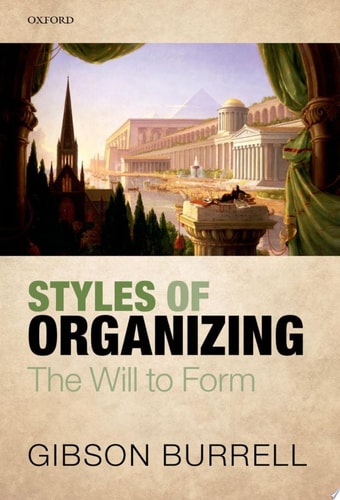
Styles of Organizing: The Will to Form
0
0
As an Amazon Associate and affiliate partner, Menrva Books earns from qualifying purchases. Learn more
Author Description
In this book, leading organization theorist Gibson Burrell presents a provocative and challenging approach to the study of organizations, aiming to move beyond the two-dimensionality of much organizational thinking and present more complex 3-D models, which allow for the 'intractions' of apparently disparate perspectives. The book aims to illuminate organization theory by discussing its interrelationship with key features of economics, architecture, aesthetics, design of the built environment, and associated artwork. He argues that by their shared 'definitions', these areas of social science and the humanities are struggling with the same issue - 'the will to form'.The author suggests that, whilst there are a huge number of possibilities for the process of organizing, the constraints of the human body, our cognitive limitations in space and time, and our relationship to nature, mean that these are necessarily limited to an 'envelope' of possibilities. He then outlines the basic parameters of the 'design envelope', analysing it through discussion of 'styles', and examines the hidden assumptions of these styles with regards the origins and potentialities of human knowledge. Burrell argues that the envelope of organizational, politico-economic, and architectural design possibilities may be seen as a cube, thus taking forward the geometrical notions of 'lines' of fight, 'points' of difference, and 'planes' of agreement to discuss the huge range of, and massive constraints upon, human organizing that are reflected in the 'will to form'. Key differences in assumptions demarcate distinct 'styles of organizing' which every reader possesses - whether they are aware of them or not.
Menrva's Summary
THE THESIS
Gibson Burrell investigates the fundamental constraints and structural patterns that govern human organizing, proposing that disparate fields like economics, architecture, and aesthetics share a common 'will to form'. Burrell, a prominent organization theorist, challenges traditional two-dimensional models of organizational thinking by introducing a three-dimensional framework. He argues that human organizing is bounded by an 'envelope' of possibilities dictated by biological, cognitive, and environmental limitations. By analyzing these constraints through the lens of 'styles', the author seeks to uncover the hidden assumptions that shape how knowledge and social structures are constructed.
THE SCOPE MAP
What You Will Find
- A three-dimensional geometric framework for analyzing organizational design.
- An interdisciplinary synthesis connecting organization theory with architecture, aesthetics, and economics.
- Analysis of the 'design envelope' as a set of constraints on human potential.
- Exploration of 'styles of organizing' and their underlying epistemological assumptions.
THE AUTHORITY PERSPECTIVE
Scholars in the field of organizational studies view this work as a dense, theoretical exploration that pushes the boundaries of traditional management literature. Readers frequently note the high level of abstraction and the interdisciplinary nature of the prose, which requires a strong background in social theory to fully navigate.
Page Count:
270
Publication Date:
2013-07-24
Publisher:
Oxford University Press
ISBN-10:
0199671621
ISBN-13:
9780199671625
Architecture
Economics
Aesthetics
Sociology
Organization Theory
Design
Community Tags
Similar Books