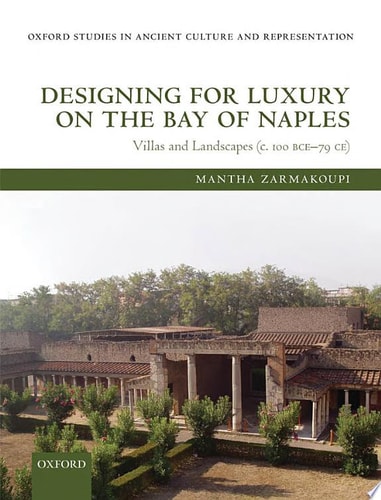
Designing for Luxury on the Bay of Naples: Villas and Landscapes (c. 100 BCE - 79 CE)
0
0
As an Amazon Associate and affiliate partner, Menrva Books earns from qualifying purchases. Learn more
Author Description
This study explores Roman luxury villa architecture and the Roman luxury villa lifestyle to shed light on the villas' design as a dynamic process related to cultural, social, and environmental factors. Roman villas expressed a novel architectural language which was developed by designers appropriating the existing stylistic and thematic vocabularies of Hellenistic and Roman architecture. Zarmakoupi seeks to describe and explain the ways in which this architecture accommodated the lifestyle of educated leisure and an appreciation of the Roman landscape, and how, in doing so, it became a cultural phenomenon and a crucial element in the construction of Roman cultural identity. In their effort to accommodate the Greek style, Romans created something completely unprecedented in the history of architecture. Through an analysis of five villas from around the bay of Naples (c. 100 BCE - 79 CE), the volume shows that in designing for luxury, Romans developed a sophisticated interplay between architecture and landscape, an interplay which is still seen in architectural design today.
Menrva's Summary
THE THESIS
This study investigates how Roman luxury villa architecture in the Bay of Naples functioned as a dynamic intersection of cultural identity, environmental adaptation, and Hellenistic design influence. Mantha Zarmakoupi, an expert in Roman architecture and landscape, utilizes archaeological evidence and architectural analysis to argue that these villas were not merely static structures but active participants in the Roman lifestyle of leisure. By examining the synthesis of Greek stylistic vocabularies with Roman spatial requirements, the author demonstrates how these designs established a new architectural language that prioritized the relationship between built environments and the natural landscape.
THE SCOPE MAP
What You Will Find
- Detailed architectural analysis of five specific luxury villas located around the Bay of Naples.
- A historical examination of the period between 100 BCE and 79 CE.
- An exploration of the integration between interior design and the surrounding natural landscape.
- A theoretical framework explaining the construction of Roman cultural identity through architectural patronage.
THE AUTHORITY PERSPECTIVE
Scholars and historians recognize this work as a significant contribution to the study of Roman domestic architecture and the evolution of landscape design. Readers frequently note the academic rigor of the text, which serves as a foundational resource for understanding the intersection of Hellenistic influence and Roman luxury.
Page Count:
352
Publication Date:
2014-01-07
Publisher:
Oxford University Press
ISBN-10:
0199678383
ISBN-13:
9780199678389
Architecture
History
Archaeology
Art History
Architecture italy
Landscapes
Social Conditions
Community Tags
Similar Books