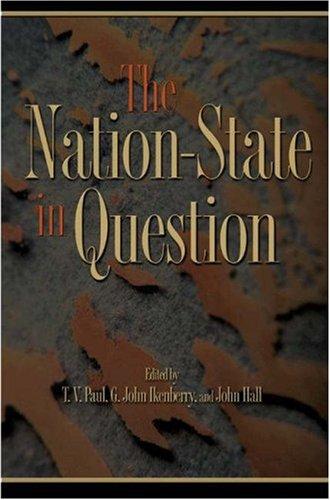
The Nation-State in Question
0
0
As an Amazon Associate and affiliate partner, Menrva Books earns from qualifying purchases. Learn more
Author Description
Has globalization forever undermined the state as the mighty guarantor of public welfare and security? In the 1990s, the prevailing and even hopeful view was that it had. The euphoria did not last long. Today the "return of the state" is increasingly being discussed as a desirable reality. This book is the first to bring together a group of prominent scholars from comparative politics, international relations, and sociology to systematically reassess--through a historical lens that moves beyond the standard focus on the West--state-society relations and state power at the dawn of the twenty-first century. The contributors examine the sources and forms of state power in light of a range of welfare and security needs in order to tell us what states can do today. They assess the extent to which international social forces affect states, and the capacity of states to adapt in specific issue areas. Their striking conclusion is that states have continued to be pivotal in diverse areas such as nationalism, national security, multiculturalism, taxation, and industrial relations. Offering rich insights on the changing contours of state power, The Nation-State in Question will be of interest to social scientists, students, and policymakers alike.
Menrva's Summary
THE THESIS
The resurgence of the state's role in public welfare and security is examined in the context of globalization's impact. This book brings together scholars from comparative politics, international relations, and sociology to reassess state-society relations and state power in the early twenty-first century, moving beyond a purely Western historical lens. The contributors investigate the origins and manifestations of state power in response to welfare and security demands, analyzing how international social forces influence states and their adaptive capacities across various issue areas. Their findings underscore the continued centrality of states in domains such as nationalism, national security, multiculturalism, taxation, and industrial relations.
THE SCOPE MAP
- A systematic reassessment of state-society relations and state power in the 21st century.
- Historical analysis that extends beyond a Western focus.
- Examination of the sources and forms of state power in relation to welfare and security needs.
- Assessment of the impact of international social forces on states.
- Analysis of state capacity to adapt in specific issue areas.
- Case studies and theoretical discussions on the pivotal role of states in nationalism, national security, multiculturalism, taxation, and industrial relations.
THE AUTHORITY PERSPECTIVE
The book is positioned as a significant contribution to the ongoing debate about the role of the state in a globalized world, offering a timely reassessment of state power. By synthesizing perspectives from comparative politics, international relations, and sociology, it aims to provide a nuanced understanding of how states continue to be pivotal actors. The collection is expected to be of interest to academics, students, and policymakers seeking insights into the evolving contours of state power.
Page Count:
400
Publication Date:
2003-01-01
ISBN-10:
0691115087
ISBN-13:
9780691115085
Non-Fiction
History
International relations
Sociology
Community Tags
Similar Books