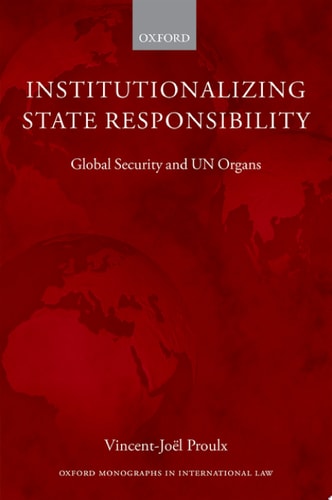
Institutionalizing State Responsibility
0
0
As an Amazon Associate and affiliate partner, Menrva Books earns from qualifying purchases. Learn more
Author Description
Since the 9/11 attacks, international organizations have become actively engaged in devising counterterrorism strategies and frameworks. This monograph examines the role UN organs can play in implementing the law of State responsibility in global security contexts, using transnational terrorism as its principal case study. The institutional mechanisms utilized by the UN in implementing State responsibility are assessed in detail, shedding light on how the ICJ, the General Assembly and the Security Council contribute to the implementation of State responsibility in the context of global security. By acknowledging the Security Council's role as a post-9/11 legislator, this book argues that the Council can play an important and sometimes determinant role in implementing a State's legal responsibility for failing to prevent terrorism, both inside and outside the Chapter VII framework.Featuring a discussion of the more controversial consequences flowing from State responsibility, this monograph also explores the prospect of injured States adopting forcible measures against responsible States for their failures to prevent terrorism. The book investigates whether self-defense and other forcible reactions, envisaged both inside and outside the Council, can be reconciled with State responsibility principles.
Menrva's Summary
THE THESIS
This monograph investigates how international organizations, specifically UN organs, can effectively implement the law of State responsibility within the context of global security and counterterrorism. Author Vincent-Joël Proulx, a scholar in international law, analyzes the intersection of institutional mechanisms and state obligations following the 9/11 attacks. The book argues that the UN Security Council, acting as a post-9/11 legislator, possesses a significant capacity to hold states accountable for failing to prevent terrorism, even beyond the traditional Chapter VII framework.
THE SCOPE MAP
What You Will Find
- Analysis of the roles of the ICJ, the General Assembly, and the Security Council in state responsibility enforcement.
- Examination of the legal reconciliation between self-defense measures and state responsibility principles.
- Case study application focusing on transnational terrorism and state failure to prevent such acts.
- Evaluation of the consequences of forcible measures adopted by injured states against responsible entities.
THE AUTHORITY PERSPECTIVE
Legal scholars and practitioners identify this work as a rigorous examination of the evolving role of international institutions in security law. Experts frequently note the technical density of the prose, making it a specialized resource for those studying the intersection of international responsibility and counterterrorism policy.
Page Count:
440
Publication Date:
2016-06-21
Publisher:
Oxford University Press
ISBN-10:
0199680396
ISBN-13:
9780199680399
Terrorism
International Law
Security Studies
National security
Law