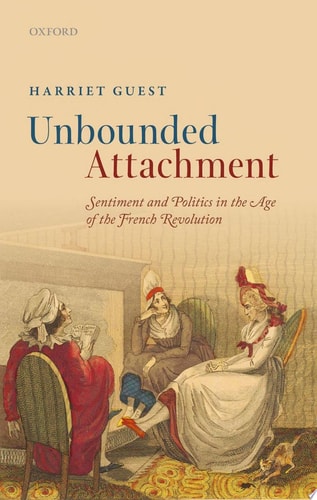
Unbounded Attachment: Sentiment and Politics in the Age of the French Revolution
0
0
As an Amazon Associate and affiliate partner, Menrva Books earns from qualifying purchases. Learn more
Author Description
Unbounded Attachment is about the uses of the language of sentiment in British women's writing from Mary Wollstonecraft to Jane Austen. It focuses on a range of writers for whom this language has the potential to hold together disparate elements in late eighteenth and early nineteenth-century society. This potential is important to the complex politics of Charlotte Smith's response, in her long poem The Emigrants, to the onset of war with France in 1793. The language of sentiment eases the transitions in Mary Robinson's writing between courtly praise for the French queen and liberal political opinion, and shapes her attitudes to the exchange between personal sociability and the expanding commercial market for her work. For women writers such as Amelia Alderson Opie and Elizabeth Inchbald the display of sentiment makes it possible to negotiate between the demands of commercial success and sociable or political allegiance. William Godwin admired Mary Wollstonecraft's capacity for an all-embracing sentiment of 'unbounded attachment' to humanity, and posthumous accounts such as Mary Hays's, as well as fictional heroines loosely based on Wollstonecraft's reputation, emphasised the strength of feeling, the enthusiasm, which united her private character and her politics, and evoked powerful responses from both her immediate social circle and her readers. The success of Jane Austen's novels depended on the access they gave readers to the privacy of her heroines' minds, where their sensibility apprehends an underlying coherence in the apparently disjointed social worlds in which they lived.
Menrva's Summary
THE THESIS
This book investigates how the language of sentiment functioned as a political and social tool in British women's writing during the volatile period of the French Revolution. Harriet H. Guest, a scholar of eighteenth-century literature, examines how authors like Mary Wollstonecraft, Jane Austen, and Charlotte Smith utilized sentimental discourse to reconcile personal identity with shifting political landscapes. By analyzing these texts, the author argues that sentiment served as a mechanism for navigating the tensions between private morality, commercial success, and public political allegiance.
THE SCOPE MAP
What You Will Find
- Analysis of late eighteenth and early nineteenth-century British literature.
- Examination of the intersection between personal sociability and the commercial literary market.
- Case studies of specific authors including Mary Wollstonecraft, Jane Austen, Charlotte Smith, and Mary Robinson.
- Exploration of how sentimental language bridged the gap between private character and public political opinion.
THE AUTHORITY PERSPECTIVE
Scholars frequently cite this work as a nuanced contribution to the study of gender and political discourse in the Romantic era. Experts highlight the text's ability to connect individual authorial strategies with the broader socio-political climate of the French Revolution.
Page Count:
224
Publication Date:
2014-01-14
Publisher:
Oxford University Press
ISBN-10:
0199686815
ISBN-13:
9780199686810
History
English & College Success
Women authors
Women and literature
Great Britain
Literary Criticism
English
18th century
British History
Community Tags
Similar Books