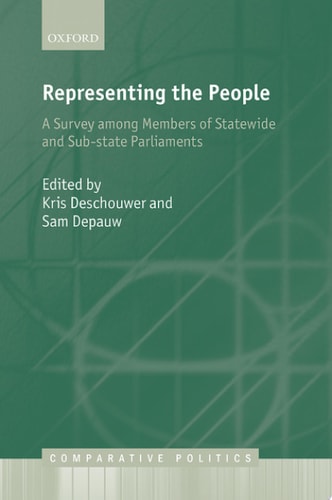
Representing the People: A Survey Among Members of Statewide and Substate Parliaments
0
0
As an Amazon Associate and affiliate partner, Menrva Books earns from qualifying purchases. Learn more
Author Description
Modern democracy is organized as a representative democracy in which those representing the people are elected to their office. Political parties play a crucial role in this. They select the candidates, form or oppose governments, and organize the work of the representatives in parliament. This model of democracy is however being criticized. Parties are hardly trusted and voters have become very volatile. One wonders then how elected representatives of the people see and fulfil their role. In order to study this, a survey was organized among the members of statewide and substate parliament in fifteen countries. Members of 73 parliamentary assemblies were asked how they perceive their representative role, what they do to keep in touch with voters and how they behave and vote in parliament and how they will try to be re-elected.One of the ways in which candidates and elected members of parliament might react to the changing conditions in which they have to represent the people is by stressing more personal characteristics as opposed to the party label and party ideology. Representation might become more a matter of personal choice. The results of the survey presented in this book do however confirm quite strongly that representation is very much shaped by the political institutions in which it is performed. Representation therefore differs between countries, between different electoral systems, between statewide and regional parliaments, and depends also strongly on the party to which a member of parliament belongs. Representation does not depend as much on who the representatives are, as on where they are.Comparative Politics is a series for students, teachers, and researchers of political science that deals with contemporary government and politics. Global in scope, books in the series are characterised by a stress on comparative analysis and strong methodological rigour. The series is published in association with the European Consortium for Political Research.
Menrva's Summary
THE THESIS
This book investigates how elected representatives in modern democracies perceive and fulfill their roles amidst declining public trust and increasing voter volatility. Authors Kris Deschouwer and Sam Depauw utilize a comprehensive survey of members across 73 parliamentary assemblies in fifteen countries to analyze the mechanics of political representation. The work argues that the behavior of representatives is primarily dictated by the specific political institutions and electoral systems in which they operate, rather than individual personal characteristics or choices.
THE SCOPE MAP
What You Will Find
- Comparative analysis of 73 parliamentary assemblies across fifteen different countries.
- Empirical data regarding how representatives maintain contact with constituents and manage re-election strategies.
- Examination of the tension between party-centered representation and personal candidate branding.
- Methodological framework for assessing the influence of electoral systems and regional versus statewide parliamentary structures.
THE AUTHORITY PERSPECTIVE
Experts in political science recognize this work as a rigorous empirical contribution to the study of legislative behavior and representative democracy. Scholars frequently cite the text for its systematic approach to cross-national comparative analysis and its clear findings on the institutional constraints of political office.
Page Count:
288
Publication Date:
2014-07-15
Publisher:
Oxford University Press
ISBN-10:
0199684537
ISBN-13:
9780199684533
Legislators
Comparative Politics
Sociology
Democracy
Representative government and representation
American Government
Government
Community Tags
Similar Books










Reader Comments
Share Your Thoughts
No comments yet. Be the first to share your thoughts!