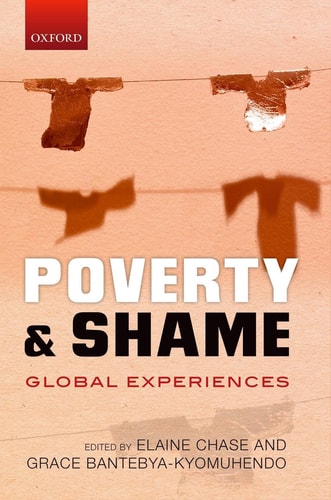
Poverty and Shame: Global Experiences
0
0
As an Amazon Associate and affiliate partner, Menrva Books earns from qualifying purchases. Learn more
Author Description
Poverty and Shame: Global Experiences explores Nobel laureate Amartya Sen's contention that shame lies at the absolutist core of poverty. It draws on a wealth of empirical evidence to demonstrate how paying greater attention to the psychological and social consequences of poverty provides new insights into how poverty is perpetuated. Based on research in seven very different global contexts, it reveals how, irrespective of whether people live above or below a designated poverty line, in cultures as diverse as rural India, Uganda and Pakistan, urban/suburban UK, China, Norway and South Korea, the ability to participate in society as a full and recognised citizen is largely contingent on having the material resources deemed normal for that society. When such means are not available, the common response is to feel inadequate and to save face by withdrawing to varying degrees from society. Such a response further limits opportunities to exit poverty and arguably results in perpetuating its cycle. Yet society in turn plays a fundamental role in what we term the poverty-shame nexus, by persistently evaluating others against dominant norms and expectations and prioritising certain explanations of poverty over others. Hence shame in relation to poverty is co-constructed, a dynamic interaction of internally felt inadequacies and externally inflicted judgements.This book, together with the companion volume The Shame of Poverty by Robert Walker invites readers to question conventional understandings about poverty and its impact. In so doing, the volumes provide a foundation for a more satisfactory global conversation about the phenomenon of poverty than that which has hitherto been frustrated by disagreement about whether poverty is best conceptualised in absolute or relative terms.
Menrva's Summary
THE THESIS
This book investigates the contention that shame serves as an absolutist core of poverty, acting as a psychological and social mechanism that perpetuates economic disadvantage. Authors Elaine Chase and Grace Bantebya-Kyomuhendo utilize empirical research across seven diverse global contexts to argue that poverty is not merely a lack of material resources but a dynamic interaction between internally felt inadequacies and externally inflicted societal judgments. By examining how individuals across varying cultures navigate social participation, the authors propose a framework that links the inability to meet societal norms with the subsequent withdrawal from public life, thereby reinforcing the cycle of poverty.
THE SCOPE MAP
What You Will Find
- Comparative analysis of poverty experiences in India, Uganda, Pakistan, UK, China, Norway, and South Korea.
- A conceptual framework defining the poverty-shame nexus as a co-constructed phenomenon.
- Empirical evidence derived from multi-site research regarding the psychological consequences of material deprivation.
- An evaluation of how societal norms and expectations prioritize specific explanations of poverty over others.
THE AUTHORITY PERSPECTIVE
Experts identify this work as a significant contribution to development studies, particularly for its focus on the intersection of sociology and economics. Readers frequently note the academic density of the prose and its utility as a foundational text for understanding the social dimensions of global poverty.
Page Count:
336
Publication Date:
2015-01-01
Publisher:
Oxford University Press
ISBN-10:
0199686726
ISBN-13:
9780199686728
Economics
Psychology
Sociology
Social Science
Poverty
Community Tags
Similar Books