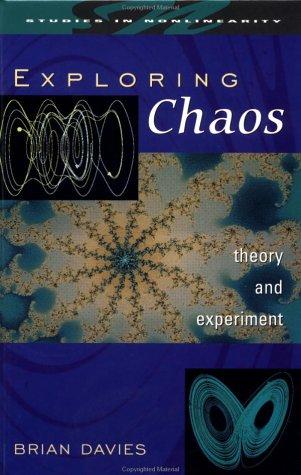
Exploring Chaos
0
0
As an Amazon Associate and affiliate partner, Menrva Books earns from qualifying purchases. Learn more
Author Description
This book presents elements of the theory of chaos in dynamical systems in a framework of theoretical understanding coupled with numerical and graphical experimentation. The theory is developed using only elementary calculus and algebra, and includes dynamics of one- and two-dimensional maps, periodic orbits, stability and its quantification, chaotic behavior, and bifurcation theory of one-dimensional systems. Here is an introduction to the theory of fractals, with an emphasis on the importance of scaling and a concluding chapter on ordinary differential equations. The software written in Java, enables students to carry out their own quantitative experiments on a variety of non-linear systems, including the analysis of fixed points and compositions of maps, visualizing orbits, final state and bifurcation diagrams, basins of attraction and box-counting for two-dimensional systems.--BOOK JACKET.
Menrva's Summary
THE THESIS
This book investigates the fundamental principles of chaos theory within dynamical systems, bridging theoretical concepts with practical computational exploration. The author, B. Davies, develops the theory using only elementary calculus and algebra, covering topics such as one- and two-dimensional maps, periodic orbits, stability, chaotic behavior, and bifurcation theory. It also introduces fractal theory, emphasizing scaling, and concludes with a chapter on ordinary differential equations. The accompanying Java software allows students to perform quantitative experiments on non-linear systems.
THE SCOPE MAP
- Exploration of dynamics in one
- and two-dimensional maps.
- Detailed analysis of periodic orbits and their stability.
- Quantification of stability and the nature of chaotic behavior.
- Introduction to bifurcation theory for one-dimensional systems.
- Foundational concepts of fractal theory, focusing on scaling.
- Application of ordinary differential equations in chaos theory.
- Use of Java software for numerical and graphical experimentation.
- Analysis of fixed points, map compositions, and visualization of orbits.
THE AUTHORITY PERSPECTIVE
The book is structured to provide a theoretical understanding of chaos theory, complemented by hands-on numerical and graphical experimentation. Its approach, utilizing only elementary calculus and algebra, suggests it is designed for students seeking an accessible yet rigorous introduction to complex mathematical concepts. The inclusion of fractal theory and differential equations broadens its scope, offering a comprehensive overview for those interested in the mathematical underpinnings of complex systems.
Page Count:
237
Publication Date:
1999-01-01
ISBN-10:
0738200905
Science
Non-Fiction
Dynamical Systems
Mathematics
Chaos Theory
Fractals
Community Tags
Similar Books