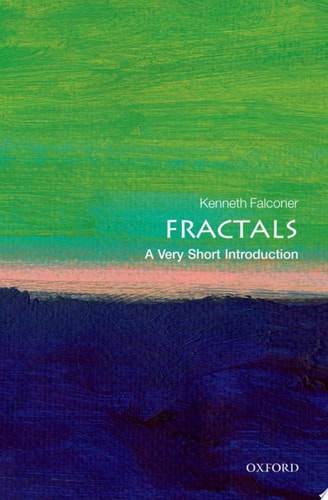
Fractals: A Very Short Introduction
0
0
As an Amazon Associate and affiliate partner, Menrva Books earns from qualifying purchases. Learn more
Author Description
Many Are Familiar With The Beauty And Ubiquity Of Fractal Forms Within Nature. Unlike The Study Of Smooth Forms Such As Spheres, Fractal Geometry Describes More Familiar Shapes And Patterns, Such As The Complex Contours Of Coastlines, The Outlines Of Clouds, And The Branching Of Trees. In This Very Short Introduction, Kenneth Falconer Looks At The Roots Of The 'fractal Revolution' That Occurred In Mathematics In The 20th Century, Presents The 'new Geometry' Of Fractals, Explains The Basic Concepts, And Explores The Wide Range Of Applications In Science, And In Aspects Of Economics. This Is Essential Introductory Reading For Students Of Mathematics And Science, And Those Interested In Popular Science And Mathematics. About The Series: The Very Short Introductions Series From Oxford University Press Contains Hundreds Of Titles In Almost Every Subject Area. These Pocket-sized Books Are The Perfect Way To Get Ahead In A New Subject Quickly. Our Expert Authors Combine Facts, Analysis, Perspective, New Ideas, And Enthusiasm To Make Interesting And Challenging Topics Highly Readable.
Menrva's Summary
THE THESIS
This book investigates the mathematical foundations and real-world applications of fractal geometry, a field that describes complex, irregular patterns found in nature. Kenneth Falconer, a professor of mathematics and an expert in the field of fractal geometry, utilizes his academic background to distill complex concepts into an accessible format. He traces the historical development of the 'fractal revolution' in the 20th century and provides a framework for understanding how these shapes differ from traditional Euclidean geometry.
THE SCOPE MAP
What You Will Find
- Historical overview of the development of fractal mathematics
- Definitions of basic fractal concepts and self-similarity
- Applications in natural sciences, geography, and economics
Scope Limits
- Advanced technical proofs or exhaustive mathematical derivations
- Comprehensive historical biography of all contributing mathematicians
THE AUTHORITY PERSPECTIVE
Experts and educators recognize this text as a reliable, concise entry point for students and laypeople interested in the mathematical underpinnings of complex systems. Readers frequently note that the prose maintains a high level of clarity while successfully navigating the inherent density of the subject matter.
Page Count:
144
Publication Date:
2013-01-01
Publisher:
Oup Oxford
ISBN-10:
0191663441
ISBN-13:
9780191663444
Science
Popular Science
Geometry
Fractals
Mathematics