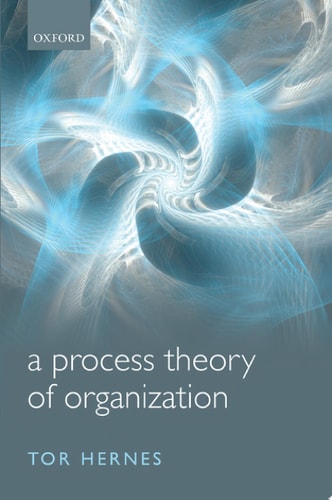
A Process Theory of Organization
0
0
As an Amazon Associate and affiliate partner, Menrva Books earns from qualifying purchases. Learn more
Author Description
This book presents a novel and comprehensive process theory of organization applicable to "a world on the move," where connectedness prevails over size, flow prevails over stability, and temporality prevails over spatiality.The process theory developed in the book draws upon process thinking in a number of areas, including process philosophy, pragmatism, phenomenology, and science and technology studies. Salient ideas from these schools are carefully woven into a process theory of organization, which makes the book not only a thought provoking theoretical contribution, but also a much needed glimpse into the challenges faced by organizers. Taking a distinctly temporal view of organizational life the author shows how actors operate in an on-going present in which they draw upon their past and project their past as ambitions for the future. This on-going work in which technologies, concepts, and social actors take part is crucial for the making of any type of organizational formation. A key construct of the book is that of events, which provide force, movement, and continuity to organizational life.The book is suitable for scholars and advanced level students in organization studies, management studies, technology studies, and sociology. It contains a number of practical examples to illustrate the theoretical framework.
Menrva's Summary
THE THESIS
This book investigates how organizational structures emerge and persist through continuous processes rather than static states. Tor Hernes, a professor of organization studies, synthesizes insights from process philosophy, pragmatism, and phenomenology to construct a framework for understanding organizations in a state of constant flux. By prioritizing temporality and flow over traditional spatial and structural models, the author argues that organizational life is defined by the ongoing interaction of actors, concepts, and technologies within a shifting present.
THE SCOPE MAP
What You Will Find
- A theoretical framework centered on the construct of events as the primary drivers of organizational movement and continuity.
- An analysis of how past experiences and future projections influence decision-making in the present.
- Integration of concepts from science and technology studies to explain organizational formation.
- Practical examples illustrating the application of process theory to real-world management challenges.
THE AUTHORITY PERSPECTIVE
Scholars and advanced students in management and sociology frequently cite this work for its rigorous application of process philosophy to organizational studies. Experts highlight the text as a significant contribution to the field for those seeking to move beyond traditional, static models of organizational behavior.
Page Count:
256
Publication Date:
2014-07-15
Publisher:
Oxford University Press
ISBN-10:
0199695075
ISBN-13:
9780199695072
Philosophy
Business
Organizational Theory
Management
Sociology
Organization
Community Tags
Similar Books