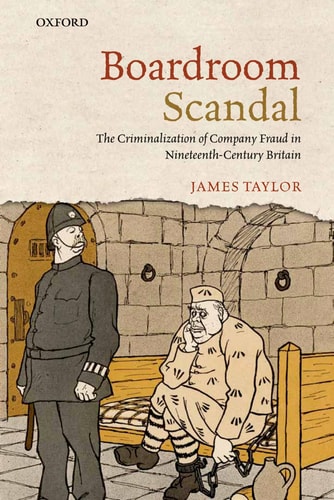
Boardroom Scandal: The Criminalization of Company Fraud in Nineteenth-Century Britain
0
0
As an Amazon Associate and affiliate partner, Menrva Books earns from qualifying purchases. Learn more
Author Description
Should businessmen who commit fraud go to prison? This question has been asked repeatedly since 2008. It was also raised in nineteenth-century Britain when the spread of corporate capitalism created enormous new opportunities for dishonesty. Historians have presented Victorian Britain as a haven for white-collar criminals, beneficiaries of a prejudiced criminal justice system which only dealt harshly with offences by the poor. Boardroom Scandal challenges these beliefs.Based on an unparalleled sample of legal cases - many examined here for the first time - James Taylor presents a radical new interpretation of the relationship between capitalism and the law. Initially, there were no criminal sanctions against publishing false prospectuses, concealing losses in balance sheets, and even misappropriating company money. But parliament became convinced of the need to criminalize these practices to protect the culture of stock market investment on which mid-Victorian prosperity increasingly rested. Persuading judges to play along was harder, with many invoking the principle of caveat emptor to exonerate defendants. But by the end of the century, successful prosecutions of company executives were commonplace. These trials performed multiple functions: they stabilized confidence in times of crisis; they dramatized the class blindness of the law; and they were increasingly seen as essential as faith in a self-regulating economy ebbed. The criminalization of fraud, therefore, has far-reaching implications for our understanding of nineteenth-century Britain. It also has relevance today in light of the on-going economic crisis and the issues it raises regarding business ethics and the role of the state.
Menrva's Summary
THE THESIS
Does the history of nineteenth-century British corporate law reveal a deliberate shift toward the criminalization of white-collar fraud to preserve economic stability? James A. Taylor, a historian specializing in Victorian economic and legal systems, utilizes an extensive dataset of previously unexamined legal cases to challenge the prevailing narrative that the Victorian justice system was inherently biased toward protecting wealthy offenders. He argues that the criminalization of corporate fraud was a strategic legislative response designed to safeguard the burgeoning stock market culture, rather than a mere byproduct of social inequality.
THE SCOPE MAP
What You Will Find
- Analysis of nineteenth-century British corporate capitalism and its relationship with the legal system.
- Examination of the transition from the principle of caveat emptor to the active prosecution of company executives.
- Evidence derived from an unparalleled sample of primary source legal cases and parliamentary records.
- Exploration of how criminal trials functioned to stabilize market confidence during periods of economic crisis.
THE AUTHORITY PERSPECTIVE
Scholars and legal historians recognize this work as a significant contribution to the study of Victorian economic regulation and the evolution of white-collar crime. Readers frequently note the meticulous archival research and the author's ability to connect historical legal precedents to contemporary debates regarding corporate accountability.
Page Count:
320
Publication Date:
2013-06-14
Publisher:
Oxford University Press
ISBN-10:
0199695792
ISBN-13:
9780199695799
Economics
History
Fraud
Victorian Era
Legal History
Business Ethics
Criminology
Community Tags
Similar Books