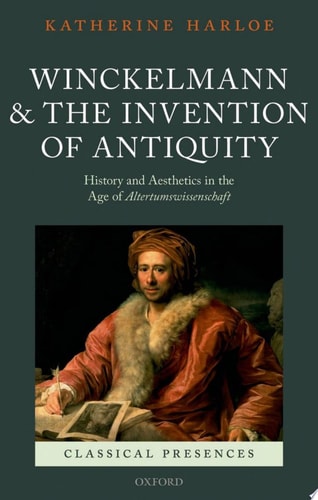
Winckelmann and the Invention of Antiquity: Aesthetics and History in the Age of Altertumswissenschaft
0
0
As an Amazon Associate and affiliate partner, Menrva Books earns from qualifying purchases. Learn more
Author Description
This volume provides a new perspective on the emergence of the modern study of antiquity, Altertumswissenschaft, in eighteenth-century Germany through an exploration of debates that arose over the work of the art historian Johann Joachim Winckelmann between his death in 1768 and the end of the century.Winckelmann's eloquent articulation of the cultural and aesthetic value of studying the ancient Greeks, his adumbration of a new method for studying ancient artworks, and his provision of a model of cultural-historical development in terms of a succession of period styles, influenced both the public and intra-disciplinary self-image of classics long into the twentieth century. Yet this area of Winckelmann's Nachleben has received relatively little attention compared with the proliferation of studies concerning his importance for late eighteenth-century German art and literature, for historians of sexuality, and his traditional status as a 'founder figure' within the academic disciplines of classical archaeology and the history of art. Harloe restores the figure of Winckelmann to classicists' understanding of the history of their own discipline and uses debates between important figures, such as Christian Gottlob Heyne, Friedrich August Wolf, and Johann Gottfried Herder, to cast fresh light upon the emergence of the modern paradigm of classics as Altertumswissenschaft: the multi-disciplinary, comprehensive, and historicizing study of the ancient world.
Menrva's Summary
THE THESIS
This volume investigates how the intellectual reception of Johann Joachim Winckelmann’s work catalyzed the development of Altertumswissenschaft, the modern, multi-disciplinary study of the ancient world, in late eighteenth-century Germany. Katherine Harloe, a scholar of classical reception, utilizes primary source debates and historical correspondence to argue that Winckelmann’s influence on the discipline of classics extends far beyond his traditional status as an art historian. By analyzing the discourse between contemporaries like Heyne, Wolf, and Herder, Harloe reconstructs the shift toward a comprehensive, historicizing paradigm of classical studies that defined the field for centuries.
THE SCOPE MAP
What You Will Find
- An analysis of the intellectual climate in eighteenth-century Germany following Winckelmann's death in 1768.
- A detailed examination of the methodological debates between key figures including Christian Gottlob Heyne, Friedrich August Wolf, and Johann Gottfried Herder.
- A historical framework tracing the transition from aesthetic appreciation of antiquity to the academic discipline of Altertumswissenschaft.
- An exploration of Winckelmann’s Nachleben and his foundational role in the self-image of modern classical archaeology and art history.
THE AUTHORITY PERSPECTIVE
Experts identify this work as a significant contribution to the history of classical scholarship, noting its success in bridging the gap between art history and the development of academic classics. Readers frequently highlight the scholarly rigor and the depth of archival research presented in the text.
Page Count:
304
Publication Date:
2013-10-15
Publisher:
Oxford University Press
ISBN-10:
0199695849
ISBN-13:
9780199695843
Philosophy
Biography
History
Art History
Archaeology
Community Tags
Similar Books