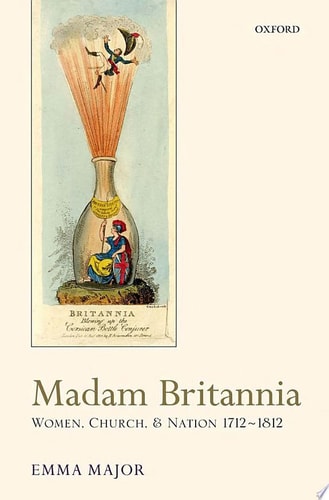
Madam Britannia: Women, Church, and Nation 1712-1812
0
0
As an Amazon Associate and affiliate partner, Menrva Books earns from qualifying purchases. Learn more
Author Description
Madam Britannia: Women, Church, and Nation, 1712-1812 explores the complex and fascinating relationship between women, Protestantism, and nationhood. Opening with a history of Britannia, this book argues that Britannia becomes increasingly popular as a national emblem from 1688 onwards. Over the eighteenth century, depictions of Britannia become exemplary as well as emblematic, her behaviour to be imitated as well as admired. Britannia takes life during the eighteenth century, stepping out of iconic representation on coins, out of the pages of James Thomson's poetry, down from the stage of David Mallett's plays, the frames of Francis Hayman and William Hogarth's paintings, and John Flaxman's monuments to enter people's lives as an identity to be experienced.One of the key strands explored in this book is Britannia's relationship to female personifications of the Church of England, which themselves often drew on key Protestant Queens such as Elizabeth I and Anne. But during the eighteenth century, Britannia also gained cultural status by being a female figure of nationhood at a time when Enlightenment historians developed conjectural histories which placed women at the centre of civilization. Women's religion, conversation, and social practice thus had a new resonance in this new, self-consciously civilized age. In this book, Emma Major looks at how narratives of faith, national identity, and civilisation allowed women such as Elizabeth Burnet, Elizabeth Montagu, Catherine Talbot, Anna Laetitia Barbauld, Hester Lynch Thrale Piozzi, and Hannah More to see themselves as active agents in the shaping of the nation.
Menrva's Summary
THE THESIS
This book investigates how the female personification of Britannia evolved from a static national emblem into a dynamic identity that allowed eighteenth-century women to claim agency within the Church of England and the broader British nation. Emma Major, a scholar of eighteenth-century literature and culture, utilizes a multidisciplinary approach to analyze how Protestantism, Enlightenment historiography, and artistic representation converged to redefine the role of women in public life. By examining the writings and social practices of figures such as Hannah More and Elizabeth Montagu, the author argues that women leveraged these cultural narratives to position themselves as active participants in the development of British civilization between 1712 and 1812.
THE SCOPE MAP
What You Will Find
- An analysis of the evolution of Britannia from numismatic icon to a lived cultural identity.
- Examination of the intersection between Protestant theology and female national personification.
- A study of Enlightenment-era conjectural histories and their impact on the perceived role of women in society.
- Biographical case studies of influential women including Elizabeth Burnet, Catherine Talbot, and Anna Laetitia Barbauld.
THE AUTHORITY PERSPECTIVE
Scholars recognize this work as a significant contribution to the study of gender and national identity in the long eighteenth century. Readers frequently note the academic rigor and the depth of the archival research presented by the author.
Page Count:
376
Publication Date:
2012-01-13
Publisher:
Oxford University Press
ISBN-10:
0199699372
ISBN-13:
9780199699377
History
Religion
Great Britain
18th century
Cultural History
Religious Life
British History
Community Tags
Similar Books