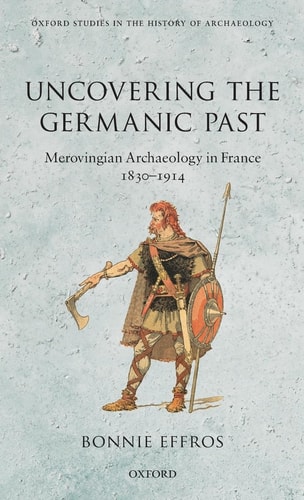
Uncovering the Germanic Past: Merovingian Archaeology in France, 1830-1914
0
0
As an Amazon Associate and affiliate partner, Menrva Books earns from qualifying purchases. Learn more
Author Description
Uncovering the Germanic Past brings to light an unexpected side-effect of France's nineteenth-century Industrial Revolution. While laying tracks for new rail lines, quarrying for stone, and expanding lands under cultivation, French labourers uncovered bones and artefacts from long-forgotten cemeteries. Although their original owners were unknown, research by a growing number of amateur archaeologists of the bourgeois class determined that these were the graves of Germanic 'warriors', and their work, presented in provincial learned societies across France, documented evidence for significant numbers of Franks, Burgundians, and Visigoths in late Roman Gaul. They thus challenged prevailing views in France of the population's exclusively Gallic ancestry, contradicting the influential writings of Parisian historians like Augustin Thierry and Numa-Denis Fustel de Coulanges. Although some scholars drew on this material evidence to refine their understanding of the early ancestors of the French, most ignored, at their peril, inconvenient finds that challenged the centrality of the ancient Gauls as the forebears of France.Crossing the boundaries of the fields of medieval archaeology and history, nineteenth-century French history, and the history of science, Effros suggests how the slow progress and professionalization of Merovingian (or early medieval) archaeology, a sub-discipline in the larger field of national archaeology in France, was in part a consequence of the undesirable evidence it brought to light.
Menrva's Summary
THE THESIS
This book investigates how the discovery of Merovingian-era artifacts in nineteenth-century France challenged established national narratives regarding the country's Gallic ancestry. Bonnie Effros, a scholar of early medieval history, examines the intersection of industrial expansion and archaeological discovery during the period between 1830 and 1914. By analyzing the work of amateur bourgeois archaeologists and their interactions with provincial learned societies, she argues that the professionalization of the field was hindered by the political and social discomfort caused by evidence of Germanic influence in early French history.
THE SCOPE MAP
What You Will Find
- A detailed examination of the impact of nineteenth-century industrialization, such as railway construction and quarrying, on the discovery of early medieval burial sites.
- An analysis of the tension between amateur archaeological findings and the prevailing academic consensus championed by Parisian historians.
- A study of how national identity and historiography influenced the acceptance or rejection of material evidence.
- An exploration of the professionalization of Merovingian archaeology as a sub-discipline within French national archaeology.
THE AUTHORITY PERSPECTIVE
Experts recognize this work as a significant contribution to the history of archaeology, particularly for its focus on the sociopolitical factors that shaped the discipline in France. Readers frequently note the academic rigor and the depth of archival research presented in this study of nineteenth-century historiography.
Page Count:
408
Publication Date:
2012-07-26
Publisher:
Oxford University Press
ISBN-10:
0199696713
ISBN-13:
9780199696710
History
European History
France
Merovingians
Historiography
Archaeology
Community Tags
Similar Books