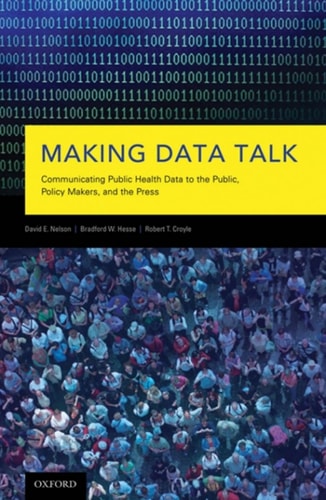
Making Data Talk: The Science and Practice of Translating Public Health Research and Surveillance Findings to Policy Makers, the Public, and the Press
0
0
As an Amazon Associate and affiliate partner, Menrva Books earns from qualifying purchases. Learn more
Author Description
The demand for health information continues to increase, but the ability of health professionals to provide it clearly remains variable. The aim of this book is (1) to summarize and synthesize research on the selection and presentation of data pertinent to public health, and (2) to provide practical suggestions, based on this research summary and synthesis, on how scientists and other public health practitioners can better communicate data to the public, policy makers, and the press in typical real-world situations. Because communication is complex and no one approach works for all audiences, the authors emphasize how to communicate data "better" (and in some instances, contrast this with how to communicate data "worse"), rather than attempting a cookbook approach. The book contains a wealth of case studies and other examples to illustrate major points, and actual situations whenever possible. Key principles and recommendations are summarized at the end of each chapter. This book will stimulate interest among public health practitioners, scholars, and students to more seriously consider ways they can understand and improve communication about data and other types of scientific information with the public, policy makers, and the press. Improved data communication will increase the chances that evidence-based scientific findings can play a greater role in improving the public's health.
Menrva's Summary
THE THESIS
This book investigates the core challenge of how public health professionals can effectively translate complex research and surveillance data into actionable information for policy makers, the press, and the general public. The authors, Bradford W. Hesse, David E. Nelson, and Robert T. Croyle, draw upon their extensive expertise in health communication and research to synthesize existing evidence on data presentation. They argue that because communication is inherently context-dependent, practitioners must move beyond rigid formulas to adopt a nuanced, evidence-based approach to information dissemination.
THE SCOPE MAP
What You Will Find
- Synthesis of current research regarding data selection and visual presentation in public health contexts.
- Practical frameworks for tailoring scientific findings to diverse audiences including policy makers and journalists.
- Extensive use of real-world case studies to illustrate effective versus ineffective communication strategies.
- Chapter-specific summaries of key principles and actionable recommendations for practitioners.
THE AUTHORITY PERSPECTIVE
Experts and practitioners in the field of public health recognize this work as a foundational text for bridging the gap between scientific research and public policy. Readers frequently note that the book provides a balanced, non-prescriptive approach that is highly applicable to the daily challenges faced by health communicators.
Page Count:
344
Publication Date:
2009-01-01
Publisher:
Oxford University Press
ISBN-10:
0199700729
ISBN-13:
9780199700721
Science
Data Analysis
Reference
Epidemiology
Medical
Allied Health
Policy
Public Health
Communication
Community Tags
Similar Books