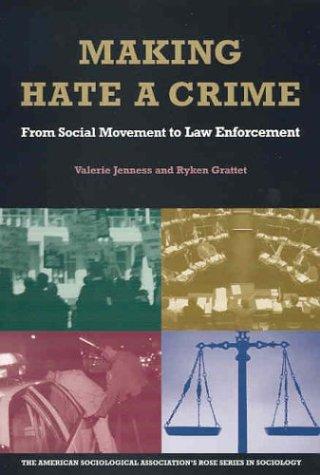
Making Hate a Crime
0
0
As an Amazon Associate and affiliate partner, Menrva Books earns from qualifying purchases. Learn more
Author Description
In Making Hate a Crime, Valerie Jenness and Ryken Grattet show how the concept of hate crime emerged and evolved over time, as it traversed the arenas of American politics, legislatures, courts, and law enforcement. In the process, violence against people of color, immigrants, Jews, gays and lesbians, women, and persons with disabilities has come to be understood as hate crime, while violence against other vulnerable victims - octogenarians, union members, the elderly, and police officers, for example - has not. The authors reveal the crucial role social movements played in the early formation of hate crime policy, as well as the way state and federal politicians defined the content of hate crime statutes, and how law enforcement has begun to distinguish between hate crime and "other" crime. Hate crime took on different meanings as it moved from social movement concept to law enforcement practice. As a result, it not only acquired a deeper jurisprudential foundation but its scope of application has been restricted in some ways and broadened in others. Making Hate a Crime reveals how our current understanding of hate crime is a mix of political and legal interpretations at work in the American policy-making process.
Menrva's Summary
THE THESIS
This book investigates the historical and political evolution of the concept of hate crime in the United States. Valerie Jenness and Ryken Grattet trace how violence against specific groups like people of color, immigrants, Jews, and LGBTQ+ individuals became legally defined as hate crimes, while similar violence against other groups was not. The authors detail the influence of social movements, politicians, and law enforcement in shaping hate crime statutes and practices. They demonstrate how the meaning and application of hate crime have shifted as it moved from a social concept to a legal and practical reality.
THE SCOPE MAP
- The emergence and evolution of the concept of hate crime in American politics, legislatures, courts, and law enforcement.
- The process by which violence against specific groups (people of color, immigrants, Jews, gays and lesbians, women, persons with disabilities) came to be understood as hate crime.
- The exclusion of violence against other vulnerable victims (octogenarians, union members, the elderly, police officers) from hate crime definitions.
- The crucial role of social movements in the early formation of hate crime policy.
- The way state and federal politicians defined the content of hate crime statutes.
- How law enforcement has distinguished between hate crime and "other" crime.
- The shifting meanings of hate crime as it moved from social movement concept to law enforcement practice.
- The impact of political and legal interpretations on the current understanding and scope of hate crime.
THE AUTHORITY PERSPECTIVE
This book is regarded as a significant historical and sociological analysis of the development of hate crime legislation and understanding in the United States. It is noted for its detailed examination of how specific groups became the focus of hate crime laws, while others were excluded, highlighting the political and social forces at play. The work is appreciated for its clear exposition of how the definition and application of hate crime have transformed over time, reflecting shifts in policy and practice. It provides a comprehensive look at the complex interplay between social movements, legislative action, and law enforcement in shaping our current understanding of hate crime.
Page Count:
218
Publication Date:
2001-01-01
ISBN-10:
0871544091
ISBN-13:
9780871544094
History
Crime
Politics
Non-Fiction
Law
Sociology
Community Tags
Similar Books