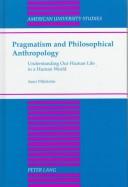
Pragmatism and Philosophical Anthropology
0
0
As an Amazon Associate and affiliate partner, Menrva Books earns from qualifying purchases. Learn more
Author Description
"Pragmatism, the single originally American philosophical tradition, has in recent decades once again become widely discussed in many fields of philosophy, including metaphysics, epistemology, philosophy of science, philosophy of religion, and moral philosophy. This study seeks to show, both historically and systematically, that the issue of "human nature," the main problem of philosophical anthropology, is (or at least should be) at the center of pragmatistic philosophizing. The author formulates a contemporary version of pragmatism largely based on William James's (1842-1910) work, arguing that such a neo-Jamesian framework also can meet postmodernistic and irrationalistic threats."--BOOK JACKET.
Menrva's Summary
THE THESIS
This study argues that the concept of human nature, central to philosophical anthropology, should be at the core of pragmatist philosophy. The author presents a contemporary interpretation of pragmatism, drawing heavily from William James, to demonstrate how this neo-Jamesian approach can effectively address postmodern and irrationalist challenges. The book explores pragmatism's resurgence across various philosophical fields, including metaphysics, epistemology, philosophy of science, philosophy of religion, and moral philosophy, positioning human nature as a unifying theme.
THE SCOPE MAP
- A historical and systematic examination of pragmatism's relationship with philosophical anthropology.
- A contemporary formulation of pragmatism, largely based on the work of William James.
- An argument for the centrality of "human nature" within pragmatist philosophizing.
- An exploration of how a neo-Jamesian framework can respond to postmodern and irrationalistic critiques.
- Discussion of pragmatism's relevance in metaphysics, epistemology, philosophy of science, philosophy of religion, and moral philosophy.
THE AUTHORITY PERSPECTIVE
The book positions pragmatism, a distinctly American philosophical tradition, as a vital contemporary force, particularly in its engagement with philosophical anthropology. The author's neo-Jamesian framework is presented as a robust response to postmodern and irrationalist thought. The work aims to demonstrate the historical and systematic centrality of the concept of human nature within pragmatist philosophy. Its scope spans multiple philosophical sub-disciplines, suggesting a comprehensive approach to the subject.
Page Count:
287
Publication Date:
1998-01-01
ISBN-10:
0820440760
Philosophy
Non-Fiction
Anthropology
American Philosophy
Community Tags
Similar Books