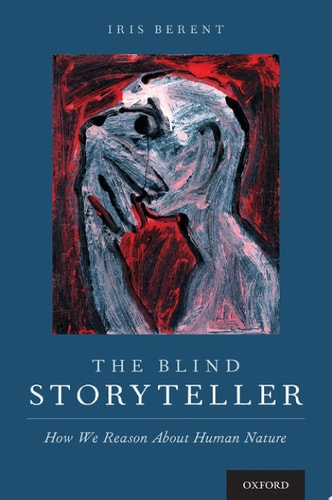
The Blind Storyteller: How We Reason About Human Nature
0
0
As an Amazon Associate and affiliate partner, Menrva Books earns from qualifying purchases. Learn more
Author Description
Do newborns think? Do they know that "three" is greater than "two"? Do they prefer "right" to "wrong"? What about emotions--can newborns recognize happiness or anger? If the answer to these questions is yes, then how are our inborn thoughts and feelings encoded in our bodies? Could they persist after we die?Going all the way back to ancient Greece, human nature and the mind-body problem have been the topics of fierce scholarly debates. But laypeople also have strong opinions about such matters. Most people believe, for example, that newborn babies don't know the difference between right and wrong--such knowledge, they insist, can only be learned. For emotions, they presume the opposite--that our capacity to feel fear, for example, is both inborn and embodied.These beliefs are stories we tell ourselves about what we know and who we are. They reflect and influence our understanding of ourselves and others and they guide every aspect of our lives. In The Blind Storyteller, the cognitive psychologist Iris Berent exposes a chasm between our intuitive understanding of human nature and the conclusions emerging from science. Her conclusions show that many of our stories are misguided. Just like Homer, we, the storyteller, are blind.How could we get it so wrong? In a twist that could have come out of a Greek tragedy, Berent proposes that our errors are our fate. These mistakes emanate from the very principles that make our minds tick: Our blindness to human nature is rooted in human nature itself.An intellectual journey that draws on philosophy, anthropology, linguistics, cognitive science, and Berent's own cutting-edge research, The Blind Storyteller grapples with a host of provocative questions, from why we are so afraid of zombies, to whether dyslexia is "just in our heads," from what happens to us when we die, to why we are so infatuated with our brains. The end result is a startling new perspective on the age-old nature/nurture debate--and on what it means to be human.
Menrva's Summary
THE THESIS
The book investigates why human intuitive beliefs about our own nature frequently contradict empirical scientific evidence. Cognitive psychologist Iris Berent utilizes her expertise in linguistics and cognitive science to argue that our misconceptions are not merely random errors, but are systematic byproducts of the very cognitive mechanisms that define human thought. By examining the tension between folk psychology and biological reality, she posits that our blindness to the true nature of the mind is an inherent feature of our evolutionary architecture.
THE SCOPE MAP
What You Will Find
- Analysis of the nature versus nurture debate through the lens of cognitive psychology.
- Examination of common intuitive beliefs regarding infant cognition, morality, and the mind-body problem.
- Synthesis of research from anthropology, philosophy, and linguistics to explain cognitive biases.
Scope Limits
- The text does not provide a comprehensive clinical guide for treating specific psychological disorders.
- It does not offer a definitive theological or metaphysical answer to the existence of the soul or afterlife.
THE AUTHORITY PERSPECTIVE
Experts and readers characterize this work as a rigorous examination of cognitive biases that challenges common-sense assumptions about human behavior. The prose is noted for its academic depth, making it a significant contribution to the public understanding of cognitive science.
Page Count:
304
Publication Date:
2020-05-01
Publisher:
Oxford University Press
ISBN-10:
0190061928
ISBN-13:
9780190061920
Psychology
Non-Fiction
Philosophy
Politics
Science
Anthropology
Social Philosophy
Psychology
Medical Books
Mind & Body
New Used & Rental Textbooks
Cognitive Psychology
Movements
Anthropology Physical
Cognitive
Consciousness & Thought
Human Nature
Physical
Community Tags
Similar Books