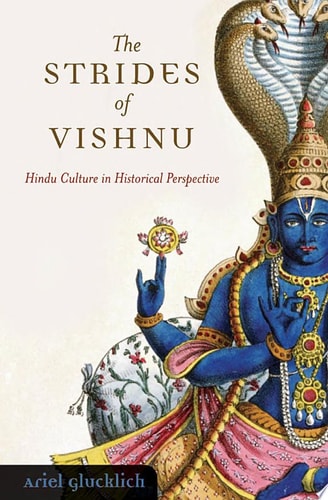
Strides of Vishnu: Hindu Culture in Historical Perspective
0
0
As an Amazon Associate and affiliate partner, Menrva Books earns from qualifying purchases. Learn more
Author Description
Books About Hinduism Often Begin By Noting The Immense Size And Complexity Of The Subject. Hinduism Is Vast And Diverse, They Say. Or It Doesn't Exist At All - Hinduism Is Merely A Convenient (and Foreign) Term That Masks A Plurality Of Traditions. In Either Case, Readers Are Discouraged By The Sense That They Are Getting Only A Tiny Sample Or A Shallow Overview Of Something Huge And Impossible To Understand. This Book Is Designed To Be Accessible And Comprehensive In A Way That Other Introductions Are Not, Maintaining An Appealing Narrative And Holding The Reader's Interest In The Unfolding Sequence Of Ideas Through Time And Place. Each Of The 13 Chapters Combines Historical Material With Key Religious And Philosophical Ideas, Supported By Substantial Quotations From Scriptures And Other Texts. The Overarching Organizational Principle Is A Historical Narrative Largely Grounded In Archaeological Information. Historic Places And Persons Are Fleshed Out As Actors In A Narrative About The Relation Of The Sacred To Ordinary Existence As It Is Mediated Through Arts, Sciences, Rituals, And Philosophical Ideas. Although Many Books Purport To Introduce The Hindu Tradition, This Is The Only One With A Broad Historical Focus That Emphasizes Archaeological As Well As Textual Evidence. It Will Nicely Complement Vasuda Narayanan's Forthcoming Introduction, Which Takes The Opposite Approach Of Focusing On The Lived Experience Of Hindu Believers.
Menrva's Summary
THE THESIS
This book investigates the historical development of Hindu traditions by synthesizing archaeological evidence with religious and philosophical texts to provide a comprehensive, accessible overview. Ariel Glucklich, a scholar of religion, addresses the common perception that Hinduism is too vast or fragmented to be understood as a singular subject. By grounding his analysis in a chronological narrative, he examines how sacred concepts have been mediated through arts, sciences, and rituals across different eras and locations. The work serves as a structured introduction that balances academic rigor with a narrative flow designed to maintain reader engagement.
THE SCOPE MAP
What You Will Find
- A chronological historical narrative spanning the development of Hindu traditions from ancient origins to the modern era.
- Integration of archaeological findings alongside traditional textual and scriptural analysis.
- Thirteen distinct chapters that examine the intersection of sacred ideas with ordinary existence.
- Detailed exploration of how arts, sciences, and rituals have shaped the evolution of Hindu culture.
THE AUTHORITY PERSPECTIVE
Experts highlight this work as a distinct contribution to the field due to its specific emphasis on archaeological data alongside textual sources. Readers frequently note that the book successfully navigates the complexity of the subject matter while maintaining a clear and accessible narrative structure.
Page Count:
256
Publication Date:
2008-01-01
Publisher:
Oxford University Press, Incorporated
ISBN-10:
0199718253
ISBN-13:
9780199718252
Religion
History
Philosophy
India
Hinduism
Archaeology
Community Tags
Similar Books