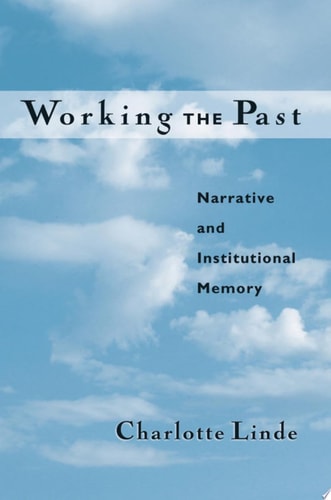
Working the Past: Narrative and Institutional Memory
0
0
As an Amazon Associate and affiliate partner, Menrva Books earns from qualifying purchases. Learn more
Author Description
Stories told within institutions play a powerful role, helping to define not only the institution itself, but also its individual members. How do institutions use stories? How do those stories both preserve the past and shape the future? To what extent does narrative construct both collective and individual identity? Charlotte Linde's unique and far-reaching study addresses these questions by looking at the interplay of narratives, memory, and identity in a large insurance company. Her detailed ethnography looks at the role of stories within the institution and how they are employed by its members in both private and group settings. Analyzing the re-telling of certain key stories, she shows how the formation of "core" stories and their multiple re-tellings and modifications provide a means of formulating and promoting a cohesive group identity -- which in turn shapes the stories and identities of the individuals within the collective. Linde also looks at silences, and how stories not told also convey their version of the past. Working the Past shows how stories that might otherwise be seen as part of mundane daily life are in fact utterly essential to the formation and maintenance of individual and group identity. Her original research will appeal to those interested in narrative studies, linguistics, anthropology, sociology, and institutional memory.
Menrva's Summary
THE THESIS
This book investigates how institutional narratives function as the primary mechanism for constructing and maintaining both collective and individual identity within a corporate environment. Charlotte Linde, a linguist and anthropologist, utilizes ethnographic research conducted within a large insurance company to analyze the structural role of storytelling. She argues that the repetition, modification, and even the deliberate omission of specific stories serve as essential tools for defining institutional culture and shaping the professional identities of its members.
THE SCOPE MAP
What You Will Find
- Ethnographic analysis of narrative practices within a large insurance corporation.
- Examination of the formation and evolution of "core" institutional stories.
- Investigation into the significance of silences and unvoiced narratives in organizational memory.
- Theoretical framework connecting linguistic storytelling patterns to the development of group identity.
THE AUTHORITY PERSPECTIVE
Scholars in the fields of organizational communication and linguistic anthropology frequently cite this work as a foundational text for understanding how memory is institutionalized. Readers often note the academic rigor of the prose, which provides a clear methodology for those studying the intersection of narrative theory and corporate culture.
Page Count:
264
Publication Date:
2008-01-01
Publisher:
Oxford University Press
ISBN-10:
0199722684
ISBN-13:
9780199722686
Anthropology
Narrative Studies
Linguistics
Corporate Image
Sociology
Community Tags
Similar Books