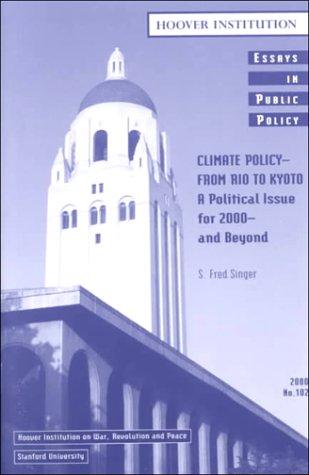
Climate Policy--From Rio to Kyoto
0
0
As an Amazon Associate and affiliate partner, Menrva Books earns from qualifying purchases. Learn more
Author Description
Within the United States, global warming and related policy issues are becoming increasingly contentious, surfacing in the presidential contests of the year 2000 and beyond. They enter into controversies involving international trade agreements, questions of national sovereignty versus global governance, and ideological debates about the nature of future economic growth and development. On a more detailed level, determined efforts are under way by environmental groups and their sympathizers in foundations and in the federal government to restrict and phase out the use of fossil fuels (and even nuclear reactors) as sources of energy. Such measures would reduce greenhouse-gas emissions into the atmosphere but also effectively deindustrialize the United States. International climate policy is based on the 1997 Kyoto Protocol, which calls on industrialized nations to carry out, within one decade, drastic cuts in the emission of greenhouse gases (GHG) that stem mainly from the burning of fossil fuels. The Protocol is ultimately based on the 1996 Scientific Assessment Report issued by the Intergovernmental Panel on Climate Change (IPCC), a U.N. advisory body. The essay attempts to trace the various motivations that led to the Kyoto Protocol. It concludes that U.S. domestic politics rather than science or economics will decide the fate of the Protocol; in particular, the presidential elections of 2000 will determine whether the United States ultimately ratifies the Protocol, which would be essential for its global enactment. Conversely, informed debate about the Protocol can influence the outcome of the elections.--BOOK JACKET.
Menrva's Summary
THE THESIS
The book investigates the contentious landscape of global warming policy, particularly focusing on the motivations behind and the political fate of the 1997 Kyoto Protocol. The author, S. Fred Singer, examines the efforts to restrict fossil fuel use and their potential impact on industrialization, contrasting scientific and economic arguments with domestic political considerations. The narrative explores how international climate policy, rooted in IPCC reports, faces significant challenges from U.S. domestic politics, with the 2000 presidential elections poised to determine the Protocol's global enactment.
THE SCOPE MAP
- Analysis of the political motivations leading to the 1997 Kyoto Protocol.
- Discussion of the role of the Intergovernmental Panel on Climate Change (IPCC) and its 1996 Scientific Assessment Report.
- Examination of efforts to restrict and phase out fossil fuels and nuclear energy.
- Exploration of the conflict between national sovereignty and global governance in climate policy.
- Assessment of the impact of U.S. domestic politics, particularly the 2000 presidential elections, on the Protocol's ratification.
- Consideration of the relationship between climate policy, international trade agreements, and economic development.
- Critique of the potential deindustrialization effects of proposed climate measures.
THE AUTHORITY PERSPECTIVE
The book frames international climate policy as a battleground for U.S. domestic politics, suggesting that scientific and economic arguments are secondary to electoral outcomes. It posits that the fate of the Kyoto Protocol hinges on the 2000 presidential elections, which will ultimately decide whether the United States ratifies the agreement. The author's perspective appears critical of the push for drastic greenhouse gas emission cuts, highlighting potential negative impacts on the U.S. economy and national sovereignty. The work aims to inform the public debate and influence the election's outcome regarding climate policy.
Page Count:
49
Publication Date:
2000-01-01
ISBN-10:
0817943722
ISBN-13:
9780817943721
Non-Fiction
Science & Technology
Economics
Politics
Community Tags
Similar Books